
Images for illustrative purposes only
Looking for Next Day delivery?
Order before 15:30 on Monday to Friday for next day delivery
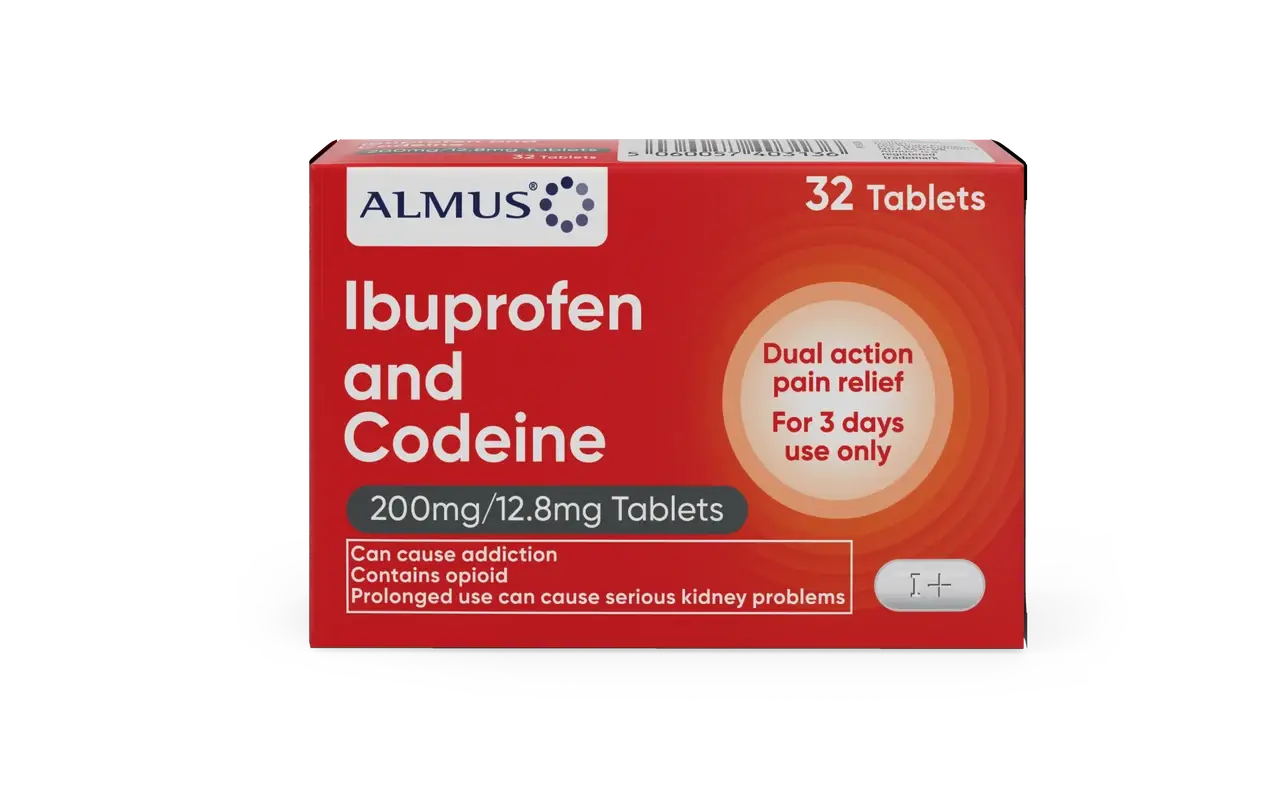
Almus Ibuprofen and Codeine 32 Tablets
- For moderate pain that paracetamol, ibuprofen or aspirin on its own has not eased - such as headache, migraine, back pain, toothache or period pain
- For adults and children aged 12 and over
- 1 or 2 tablets up to three times a day, at least 4 hours apart, and no more than 6 in 24 hours
- Take it for 3 days at most - it contains codeine, which can cause addiction
- A pharmacy medicine - our pharmacist checks your health answers before it is sent
This product is for short term use only. The pharmacist can only supply 1 box per patient per order.
What it is for
Almus Ibuprofen and Codeine Tablets treat moderate pain that has not got better with paracetamol, ibuprofen or aspirin on its own. It is used for headaches, migraine, back pain, rheumatic and muscular pain, period pain, dental pain and nerve pain (neuralgia).
It is for short bursts of pain. You should take it for no more than 3 days at a time.
Adults and children aged 12 and over can take it.
Next step: answer the health questions when you order. Our pharmacist checks them before your tablets are sent. Need pain relief for longer than 3 days? Talk to your doctor or pharmacist instead.
This medicine contains codeine, an opioid. It can cause addiction if you take it continuously for more than 3 days. That can give you withdrawal symptoms when you stop. And if you take it for headaches for more than 3 days, it can make them worse.
Is it right for you?
Do not take it if you:
- are under 12
- are allergic to ibuprofen, codeine or any other ingredient in it, or to aspirin or other painkillers
- have had asthma get worse, a skin rash, an itchy runny nose or a swollen face after taking ibuprofen, aspirin or a similar medicine
- have, or have had two or more episodes of, a stomach ulcer, a hole in the stomach or gut (perforation) or bleeding
- have had bleeding or a perforation in your gut while taking an anti-inflammatory painkiller (NSAID)
- have severe liver, kidney or heart problems
- have breathing problems, such as slowed breathing (respiratory depression)
- have raised pressure inside your head (raised intracranial pressure)
- have long-term constipation
- are taking other NSAID painkillers, or aspirin at more than 75 mg a day
- are in the last 3 months of pregnancy
- are breastfeeding
- are taking a type of antidepressant called an MAOI, or have taken one in the last 14 days
- know that your body turns codeine into morphine very quickly
Never give it to anyone under 18 for pain after their tonsils or adenoids are taken out because of obstructive sleep apnoea.
Talk to a pharmacist or doctor before taking it if you:
- have or have had asthma
- have heart problems, such as heart failure or angina (chest pain)
- have had a heart attack, heart bypass surgery, or any kind of stroke, even a mini-stroke (TIA)
- have poor circulation in your legs or feet because of narrow or blocked arteries (peripheral artery disease)
- might be at risk of heart problems or stroke - high blood pressure, diabetes, high cholesterol and smoking all raise it
- have low or high blood pressure
- have kidney, liver or bowel problems, or are dehydrated
- have had ulcerative colitis or Crohn's disease
- have lupus (SLE), a condition of the immune system
- have a head injury, a thyroid problem, Addison's disease, gallstones, prostate problems or myasthenia gravis (a condition that causes muscle weakness)
- have an infection, or chickenpox
- are in the first 6 months of pregnancy, or are trying to get pregnant
Aged 12 to 18? You may get kidney problems if you are dehydrated. If you are older, take care too, because the risk of breathing problems is higher.
Codeine and addiction
Taken the way the pack says, it is unlikely you will become addicted. The risk comes with taking it for longer than 3 days, or taking more than the dose.
Codeine is an opioid. Used again and again, it can work less well over time (tolerance). It can also lead to dependence, misuse and addiction, which may result in a life-threatening overdose. Taking more than the dose, or taking it for too long, also risks serious harm to your stomach, gut and kidneys. It can make the potassium in your blood very low. These harms can be fatal.
Your risk may be higher if:
- you or anyone in your family has ever misused or been dependent on alcohol, prescription medicines or illegal drugs
- you smoke
- you have ever had problems with your mood, such as depression, anxiety or a personality disorder
- a psychiatrist has treated you for another mental illness
Signs it may be becoming a problem:
- you need to take it for longer than advised
- you need more than the recommended dose
- you feel you need to keep taking it even when it does not ease your pain
- you are taking it for reasons other than pain, for instance to stay calm or to help you sleep
- you have tried to stop or cut down, more than once, and could not
- you feel unwell when you stop, and better once you take it again (withdrawal)
If any of these sound familiar, speak to your doctor. They can talk through the right treatment for you, and when and how to stop safely.
Why codeine may work differently for you
Your liver uses an enzyme to turn codeine into morphine, and morphine is what relieves the pain. This enzyme varies from person to person. You may make very little morphine, so codeine gives you poor pain relief. Or you may make a very high amount, which makes serious side effects more likely - the side effects tab lists the signs to stop and get help.
Your heart, stomach and kidneys
The ibuprofen in this tablet is an anti-inflammatory painkiller. Medicines like it may be linked with a small increased risk of heart attack or stroke. Any risk is more likely with high doses or long treatment. So keep to the dose, and to 3 days at most.
Taken at more than the recommended dose, or for a long time, it can damage your kidneys. It can stop them removing acid from your blood properly (renal tubular acidosis) and cause very low potassium. This is a very serious condition that needs treatment straight away. Signs include muscle weakness and feeling light-headed.
It can also hide the signs of an infection, such as fever and pain. If you have an infection and it does not get better, or gets worse, see a doctor without delay.
Medicines like this one may make it harder to get pregnant while you are taking them. This goes back to normal once you stop. Occasional use is unlikely to affect your chances, but tell your doctor before taking it if you have problems getting pregnant.
How to take it
Swallow 1 or 2 tablets with water.
- Take it only when you need it, up to three times a day.
- Leave at least 4 hours between doses.
- The most you can take in any 24 hours is 6 tablets.
- Stop after 3 days at most.
- Do not take any other medicine that contains codeine while you are taking it.
If it is not easing your pain, ask a healthcare professional for advice rather than taking more. See your doctor or pharmacist if your symptoms carry on, your pain or fever gets worse, or anything new starts.
If you take too many, or a child takes some by accident, always contact a doctor or your nearest hospital. They can tell you the risk and what to do. Signs can include feeling sick, stomach pain, being sick (which may have blood in it), headache, ringing in the ears, confusion and shaky eye movements. At high doses you may get drowsiness, chest pain, a pounding heartbeat (palpitations) or fits (mainly in children). You may also get weakness, dizziness, blood in your urine, a cold feeling or breathing problems, or you may lose consciousness.
When you stop, you may get withdrawal symptoms if you have taken it continuously for more than 3 days. Talk to your doctor or pharmacist if you think you have them.
Alcohol and driving
Do not drink alcohol while you are taking it. Alcohol may make you feel more drowsy.
It can make you feel sleepy or dizzy. Do not drive or use machines until you know it is not affecting you. It is an offence to drive if this medicine affects your ability to drive. If you are not sure whether it is safe for you to drive, ask your doctor or pharmacist.
Pregnancy and breastfeeding
Do not take it in the last 3 months of pregnancy. It could harm your baby or cause problems at delivery, and it can make labour start later or last longer.
In the first 6 months, take it only if it is absolutely necessary and your doctor has advised it. From 20 weeks, taking it for more than a few days can cause kidney problems in your baby. That can lead to low levels of the fluid around the baby, or narrowing of a blood vessel in the baby's heart.
Do not take it while breastfeeding. Codeine and morphine pass into breast milk.
Other medicines
Always ask your doctor or pharmacist before taking it with other medicines, even herbal and homeopathic ones. Tell them about anything you take for:
- blood thinning: warfarin, ticlopidine, or aspirin
- blood pressure and fluid: ACE inhibitors such as captopril, beta-blockers such as atenolol, angiotensin-II receptor blockers such as losartan, and water tablets (diuretics)
- depression or anxiety: SSRIs, SNRIs, MAOIs, moclobemide, hydroxyzine and tricyclic antidepressants
- sleep and calming: sleeping tablets and sedatives, such as benzodiazepines
- mental health: antipsychotics, such as phenothiazines, and lithium for bipolar disorder
- nerve pain or epilepsy: gabapentin or pregabalin
- stomach and gut: loperamide or kaolin for diarrhoea, metoclopramide or domperidone for sickness, and cimetidine
- heart rhythm: quinidine or mexiletine
- other conditions: muscle relaxants, quinolone antibiotics, corticosteroids, methotrexate, abiraterone, zidovudine, ciclosporin or tacrolimus
Taken mifepristone (for ending a pregnancy) in the last 12 days? Do not take ibuprofen. And if you are having a general anaesthetic, tell your doctor you are taking this medicine.
What it is and how it works
Each tablet holds two painkillers. Ibuprofen 200 mg is a non-steroidal anti-inflammatory drug (NSAID), so it also brings down swelling (inflammation). Codeine phosphate 12.8 mg is an opioid painkiller, which works once your liver has turned it into morphine.
What it will not do
- It is not for long-term or everyday pain. Past 3 days, you need advice, not more tablets.
- It is not for children under 12.
Looking for something else? Browse our pain relief range, or ask our pharmacy team which option suits your pain.
If you get side effects, they are most likely to be uncommon, affecting up to 1 in 100 people. None are common.
- Stop taking this medicine and get medical help straight away if you get signs of gut bleeding, a serious allergic or skin reaction, chest pain, meningitis, kidney problems, or too much morphine.
- Signs of bleeding in your gut: bright red or black, tarry stools, vomiting blood, or dark bits that look like coffee grounds
- Signs of a serious allergic reaction: a severe rash, or peeling, flaking or blistering skin. Watch too for a swollen face, sudden wheezing, shortness of breath or easy bruising
- Chest pain, which can be a sign of a serious allergic reaction called Kounis syndrome
- Reddish flat patches on your body, shaped like targets or circles. They often have blisters in the middle, with peeling skin or ulcers in the mouth, throat, nose, genitals or eyes. These serious rashes can start with fever and flu-like symptoms
- A widespread rash with a high temperature and swollen glands (DRESS)
- A red, scaly, widespread rash with bumps and blisters, and a fever, when you first start taking it (AGEP)
- Signs of meningitis: a stiff neck, headache, fever or feeling disorientated
- Signs of kidney problems: passing more or less urine, or blood in your urine, or cloudy urine. You may also feel breathless, very tired or weak, lose your appetite, or get swollen ankles
- Signs your body is making too much morphine from the codeine: slow or shallow breathing, confusion, sleepiness or small pupils. Feeling or being sick, constipation and loss of appetite can be signs too
Severe pain high in your tummy, which may spread to your back, with feeling sick, being sick or a fever? Contact your doctor. It could be inflammation of the pancreas (pancreatitis) or a problem with the bile system.
Uncommon - may affect up to 1 in 100 people:
- indigestion, heartburn or feeling sick (nausea)
- stomach pain or other unusual stomach symptoms
- rashes or itching
- headache
Rare - may affect up to 1 in 1,000 people:
- constipation
Very rare - may affect up to 1 in 10,000 people:
- liver and kidney problems
Not known - how often cannot be estimated from the data:
- asthma getting worse
- sweating, thirst, muscle weakness or shaking, and trouble sleeping
- a fast or irregular heartbeat
- dizziness or drowsiness
- being more sensitive to pain
- skin that is more sensitive to sunlight
- an inflamed pancreas (pancreatitis), or a problem with a valve in the gut (sphincter of Oddi). Signs include bad pain high in your tummy, which may spread to your back. You may also feel or be sick, or have a fever
Medicines like this one may also be linked with a small increased risk of heart attack or stroke.
Too much, or for too long, can harm your kidneys and lower your potassium. The overview lists the signs. You can report any side effect to the MHRA through the Yellow Card scheme. Or search for MHRA Yellow Card in the Google Play or Apple App Store.
What kind of pain is it for?
Moderate pain that has not eased with paracetamol, ibuprofen or aspirin alone. Examples are headaches, migraine, back pain, rheumatic and muscular pain, period pain, dental pain and nerve pain (neuralgia). It is for short-term pain only.
Why can I only take it for 3 days?
Codeine can cause addiction if you take it continuously for more than 3 days, and you may get withdrawal symptoms when you stop. If you still need pain relief after 3 days, see your doctor or pharmacist.
Can I take it for headaches or migraine?
Yes - both are among the pains it is licensed for. Keep to 3 days, though. If you take a painkiller for headaches for more than 3 days, it can make them worse.
Can teenagers take it?
Yes, from age 12. The dose for 12 to 18 is the same as for adults. Kidney problems are more likely if they are dehydrated. It must never be used for pain after the tonsils or adenoids are removed because of obstructive sleep apnoea.
How do I know if I am becoming addicted?
If you take it the way the pack says, addiction is unlikely. Talk to your doctor if you need it for longer, or need more than the dose. The same goes if you feel very unwell when you stop, and better once you start again. The full list of signs is in the overview.
Can I drink alcohol while taking it?
No. Do not drink alcohol while you take it, because alcohol may make you feel more drowsy.
Can I drive?
Not until you know how it affects you. It can make you sleepy or dizzy, and it is an offence to drive if this medicine affects your ability to drive.
Can I take it with other painkillers?
Do not take it with other anti-inflammatory painkillers (NSAIDs), or with aspirin at more than 75 mg a day. Do not take any other medicine that contains codeine either. For anything else, check with our pharmacist first.
Is it the same as Nurofen Plus?
Each tablet has the same two active ingredients in the same amounts: 200 mg ibuprofen and 12.8 mg codeine phosphate. Both are licensed for the same kinds of pain, from age 12, for up to 3 days. They are made by different companies, and each has its own list of inactive ingredients. If you have an allergy, check the list for the one you are buying.
Can I take it if I am pregnant or breastfeeding?
Not in the last 3 months of pregnancy, and not while breastfeeding. In the first 6 months of pregnancy, only if it is absolutely necessary and your doctor advises it.
Does it contain lactose?
No - lactose is not one of its ingredients. It contains less than 1 mmol sodium (23 mg) per tablet, which means it is essentially sodium-free. The full list is in the Other tab.
What should I do if I take too many?
Always contact a doctor or your nearest hospital, who can tell you the risk and what to do. Do the same if a child takes any by accident.
Ingredients
- Active ingredients: ibuprofen 200 mg and codeine phosphate hemihydrate 12.8 mg in each tablet
- Tablet core: microcrystalline cellulose, sodium starch glycolate, pregelatinised maize starch, hypromellose
- Tablet coating: hypromellose, titanium dioxide (E171), talc
Each tablet contains less than 1 mmol sodium (23 mg) - essentially sodium-free.
What the tablets look like
White, capsule-shaped tablets marked "I+" on one side. This pack holds 32 tablets.
Storage
- No special storage conditions are needed.
- Keep it somewhere safe and secure that other people cannot get to. It can cause serious harm, and be fatal, to someone it was not meant for.
- Keep it out of the sight and reach of children.
- Do not use it after the expiry date on the foil or the carton flap.
- Do not throw medicines down the drain. Ask your pharmacist how to get rid of any you no longer need.
Licence and maker
A pharmacy medicine (P), licence number PL 00014/0662. The licence holder is The Boots Company PLC, Nottingham. It is made by Custom Pharmaceuticals Ltd, Hove, and sold under the Almus brand.
Leaflet
Read the leaflet in the pack before you take the first tablet. Large print, Braille and audio copies are free on 0800 198 5000 (UK only). The Royal National Institute of Blind People runs this service.
Related
- Nurofen Plus - the same two active ingredients, from a different maker
- Pain relief - our full range
Sources
The facts on this page come from these documents:
- Ibuprofen and Codeine 200mg/12.8mg Tablets - Summary of Product Characteristics (emc) - The Boots Company PLC. Same licence as the Almus pack (PL 00014/0662). Revised 2 September 2026
- Almus Ibuprofen and Codeine 200 mg/12.8 mg Tablets - patient information leaflet (MHRA) - licence PL 00014/0662, last revised August 2026
- Public assessment report, Ibuprofen and Codeine 200mg/12.8mg film-coated tablets (MHRA) - legal category (pharmacy medicine) and the UK pack size limit
- Nurofen Plus - Summary of Product Characteristics (emc) - Reckitt Benckiser Healthcare (UK) Ltd. Revised 29 April 2026. Used for the FAQ comparison
- MHRA Yellow Card scheme - how to report a side effect
The leaflet inside your pack is the one that applies to your tablets. Last checked against these sources: 13 October 2026.

