
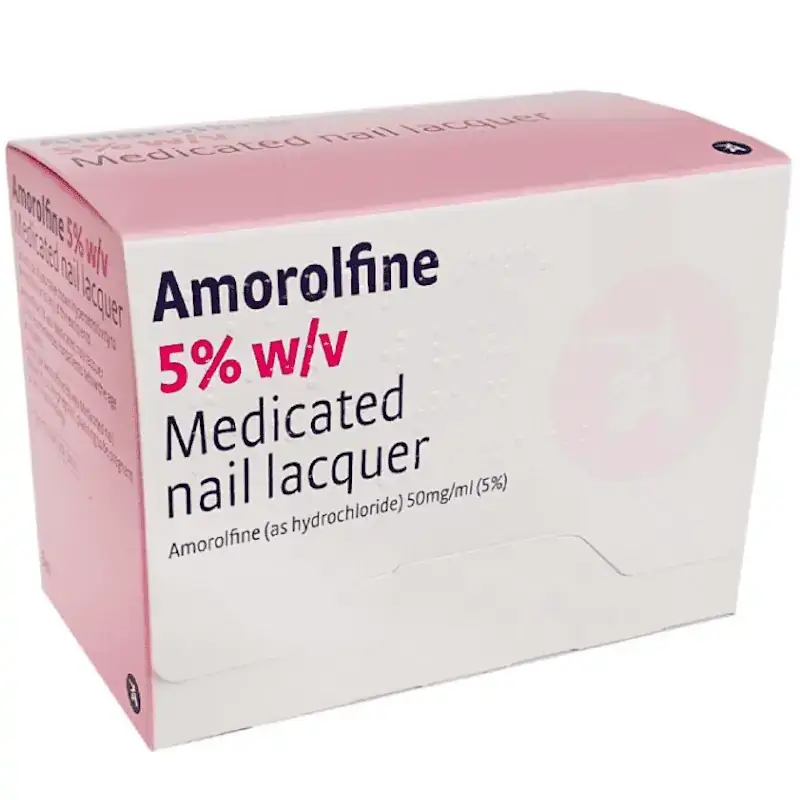
Images for illustrative purposes only
Looking for Next Day delivery?
Order before 15:30 on Monday to Friday for next day delivery
Amorolfine Nail Lacquer
- Treats mild fungal nail infections on your fingernails or toenails, when only 1 or 2 nails are affected
- Just once a week - file and clean the nail, then paint the lacquer over the whole nail
- Keep going until a healthy nail grows back, usually 6 months for fingernails and 9 to 12 months for toenails
- You can wear nail varnish over it, once the lacquer has had 10 minutes to dry
What amorolfine nail lacquer is for
Is a nail turning white, yellow or brown? Has it gone thick or brittle? These can be signs of a fungal nail infection. This lacquer treats mild fungal nail infections on fingernails and toenails.
You paint it on once a week. It soaks into the nail and works on the fungus underneath.
It is for a mild infection only. That means 1 or 2 nails, with the infection in the upper half and edge of the nail.
Next step: this is a general sale medicine - add it to your basket, and ask our pharmacist if you need advice. You do not need a prescription.
Is it right for you?
It may suit you if you are 18 or over and:
- you have 1 or 2 infected nails
- the infection is in the upper half and edge of the nail
- the nail is discoloured, thick or brittle, but not badly damaged
Do not use it, and see your doctor instead, if:
- you have more than 2 infected nails
- the nail is moderately or badly damaged
- the infection has spread beyond the upper half and edge of the nail
- you have pain or swelling around the nail
- you have dark stripes running down the nail
- you have diabetes
- you have a weak immune system
- you have poor blood circulation in your hands or feet
- you are under 18
Do not use it if you are pregnant, might become pregnant or are breastfeeding. Do not use it if you are allergic to amorolfine or any of the other ingredients (listed in the Other tab).
- Diabetes, a weak immune system or poor circulation? These can make a fungal nail infection more likely. Please see your doctor rather than treating it yourself.
How to use it
The pack comes with nail files, cleaning swabs and reusable applicators. The first time:
- File the nail. Use a new file from the pack. Gently file down the infected parts of the nail, including the top surface. Do not use the same file on your healthy nails, or you could spread the infection.
- Clean the nail. Wipe the surface with one of the swabs provided. Keep the swab - you will need it again.
- Paint it on. Dip one of the reusable applicators into the bottle. Do not wipe it on the bottle neck. Spread the lacquer evenly over the whole nail.
- Let it dry for about 3 minutes.
- Clean the applicator with the same swab, without touching your treated nail. Close the bottle tightly.
Throw the swab away with care. It catches fire easily.
Each week after that, remove the old lacquer and any nail varnish with a swab. File the nail again if you need to. Then repeat steps 3 to 5.
Once it is dry, soap and water will not wash it off. You can wash your hands and feet as normal.
- Nails only. Do not put it on the skin around the nail. Keep it away from your eyes, ears, mouth and nostrils, and do not breathe it in. If it gets in your eyes or ears, wash it out with water and talk to your pharmacist or doctor, or go to the nearest hospital straight away.
How long it takes
Nails grow slowly. You may not see a change for 2 or 3 months.
Keep using it once a week until the infection has gone and a healthy nail has grown back. This usually takes 6 months for fingernails and 9 to 12 months for toenails. If you stop too soon, or skip weeks, it may not work and the fungus could become resistant to it.
Check your nail every 3 months. A photo or a quick sketch of the infected area helps you see the change. If it is getting better, carry on. If it looks the same or worse, talk to your doctor or pharmacist.
Still infected after 6 months (fingernails) or 12 months (toenails)? See your doctor.
Nail varnish, false nails and daily life
- Nail varnish: you can wear it. Wait at least 10 minutes after the lacquer before you paint your nails. Take the varnish off carefully before your next weekly dose.
- Artificial nails: do not wear them while you use this treatment.
- Paint thinners or white spirit: wear rubber or other waterproof gloves. These solvents can strip the lacquer off your fingernails.
- Nail files: keep the files for your own infected nails. Do not let anyone else use them.
- Flammable. It contains alcohol (ethanol). Keep it away from fire and flames.
What it is and how it works
The active ingredient is amorolfine, an antifungal. It soaks through the hard nail plate to reach fungus in the nail bed underneath. There, it stops the fungus making a substance (ergosterol) it needs for its outer layer, and the fungus dies.
Very little gets into the rest of your body.
We also sell the branded version, Curanail 5% nail lacquer.
What it will not treat
It is only for mild fungal infections of 1 or 2 nails. It does not treat athlete's foot or other fungal skin rashes. If you have athlete's foot as well, treat your skin with an antifungal cream - see our fungal infection treatments.
Not sure it is a fungal infection? Ask our pharmacist.
Like all medicines, it can cause side effects, although not everybody gets them. Side effects are rare.
- Stop using it and get urgent medical help if you have trouble breathing, your face, lips, tongue or throat swell, or you get a severe skin rash. These are signs of a serious allergic reaction. Take the lacquer off with nail varnish remover or a cleaning swab, and do not use it again.
Rare (may affect up to 1 in 1,000 people):
- nail damage
- a change in nail colour
- fragile or brittle nails
These nail changes can also be caused by the infection itself.
Very rare (may affect up to 1 in 10,000 people):
- a burning feeling on the skin
Not known (frequency cannot be estimated):
- a serious allergic reaction affecting the whole body (see the red box above)
- redness, itching, hives or blisters
- an allergic skin reaction (contact dermatitis)
If you get any allergic reaction, stop using it, take it off and get medical advice. Do not put it on again.
Reporting side effects
If you get any side effect, talk to your doctor, pharmacist or nurse. You can also report it to the MHRA through the Yellow Card scheme. Reporting helps everyone learn more about the safety of medicines.
How do I know if I have a fungal nail infection?
Fungal nail infections can look very different. The nail may turn white, yellow or brown. It may get thicker, or become brittle and break. If you are not sure, ask our pharmacist before you start.
What counts as a mild infection?
One or 2 nails, with slight discolouration in the upper half and edge of the nail. The nail may be a little thicker and more brittle. If more nails are affected, the nail is badly damaged, or it hurts or is swollen, see your doctor instead.
How often do I use it?
Once a week on each infected nail. File and clean the nail first every time.
When will I see a difference?
Nails grow slowly, so it may take 2 or 3 months. You will see a healthy nail growing as the infected part grows out.
How long will I need to use it?
Until a healthy nail has grown back. That usually takes 6 months for fingernails and 9 to 12 months for toenails. Do not stop just because the nail looks better.
What if I forget a week?
Do not worry. Use it as soon as you remember, in the same way as before. A diary can help you remember.
Can I wear nail varnish?
Yes. Wait at least 10 minutes after putting the lacquer on. Take the varnish off carefully before your next weekly dose.
Can I wear false nails?
No. Do not wear artificial nails while you use it.
I have diabetes. Can I use it?
No. See your doctor instead. Diabetes, a weak immune system and poor circulation in your hands or feet can all make nail infections more likely, and they need a doctor's care.
Can I use it if I am pregnant or breastfeeding?
No. Do not use it if you are pregnant, might become pregnant or are breastfeeding.
I have athlete's foot too. Will this treat it?
No. The lacquer is for nails only. Treat the skin on your feet with an antifungal cream at the same time.
Can I use it with my other medicines?
You can normally use it while you take other medicines. Tell our pharmacist about anything else you use, including medicines you bought without a prescription and herbal remedies.
What if someone swallows it?
Talk to a doctor or pharmacist, or go to the nearest hospital, straight away.
Ingredients
- Active ingredient: amorolfine 5% w/v (50 mg per ml), as amorolfine hydrochloride
- Other ingredients: ammonio methacrylate copolymer A, triacetin, butyl acetate, ethyl acetate, ethanol
Pack
One 3 ml glass bottle of nail lacquer, with cleaning swabs, nail files and reusable applicators (spatulas).
Storage
- Keep it away from heat.
- Keep the bottle tightly closed after use.
- Keep it away from fire and flames.
- Keep it out of the sight and reach of children.
- Do not use it after the expiry date on the pack.
- Do not throw medicines down the drain or in household rubbish. Ask your pharmacist how to get rid of any you no longer need.
Licence
This is a general sale medicine (GSL). The leaflet inside your pack is the one that applies to your lacquer. Read it before you start.
Sources
The facts on this page come from these documents:
- Amorolfine 5% w/v Medicated Nail Lacquer - Summary of Product Characteristics (emc) - Aspire Pharma, revised 14 June 2021
- Amorolfine 5% w/v Medicated Nail Lacquer - patient information leaflet (emc) - Aspire Pharma, revised April 2021
- Curanail 5% w/v Medicated Nail Lacquer - Summary of Product Characteristics (emc) - Galderma (U.K.), revised 30 September 2026
- Curanail 5% w/v Medicated Nail Lacquer - patient information leaflet (emc) - Galderma (U.K.), revised September 2026
- MHRA Yellow Card scheme - how to report a side effect
Last checked against these sources: 10 November 2026.

