
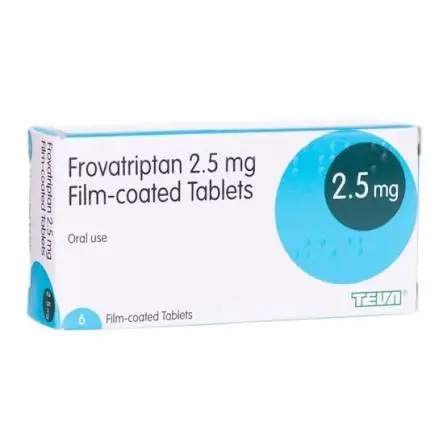
Images for illustrative purposes only
Looking for Next Day delivery?
Order before 15:30 on Monday to Friday for next day delivery
Frovatriptan Tablets
- Treats the headache of a migraine attack, with or without aura, and the sickness and sensitivity to light and sound that can come with it
- For adults aged 18 to 65 whose migraine has been diagnosed by a doctor
- One tablet as soon as the headache starts. It does not prevent migraines
What it is for
Frovatriptan treats migraine headache. You take it once the headache has started. It helps take away the head pain. It can also ease the other symptoms of an attack, like feeling or being sick, and being sensitive to light and sound.
It works for migraine with or without aura. An aura is a warning sign you may get before the pain starts. It can be flashing lights or zigzag lines. Frovatriptan belongs to a group of migraine medicines called triptans.
Next step: answer our health questions about your migraine, your heart and blood pressure, and any other medicines you take. A prescriber checks them before your tablets are sent.
Not sure your headaches are migraine? Have them checked by your GP first. Our migraine page explains the types of migraine and other treatments.
Chest pain or tightness can happen after a triptan. It may be strong and spread to your throat. If it does not pass quickly, stop taking frovatriptan and tell your doctor straight away. Get emergency help if the pain spreads to your arms, neck or jaw, or you feel clammy or short of breath. These may be signs of a heart attack.
Is it right for you?
Do not take frovatriptan if you:
- are allergic to frovatriptan or any other ingredient in the tablets
- have or have had heart disease, a heart attack or angina (chest pain caused by too little oxygen reaching the heart)
- have signs of heart disease, such as breathlessness, extreme tiredness or swollen ankles
- have had chest pain from a spasm of the heart's blood vessels (Prinzmetal's angina)
- have poor circulation in your legs or arms (peripheral vascular disease)
- have high blood pressure that is moderate or severe, or mild high blood pressure that is not being treated
- have had a stroke or a mini-stroke (transient ischaemic attack, or TIA)
- have severe liver disease
- take ergotamine or a medicine like it for migraine, such as methysergide
- take another triptan, such as sumatriptan, almotriptan, eletriptan, naratriptan, rizatriptan or zolmitriptan
It is also not for hemiplegic migraine, which causes weakness down one side of the body. Nor is it for basilar migraine, which starts in the brainstem, or ophthalmoplegic migraine, which affects the muscles that move the eye.
Tell our prescriber before you order if you:
- smoke heavily, or use nicotine replacement such as patches or gum
- are a woman past the menopause, or a man over 40, with any risk of heart disease
- take an antidepressant, especially an MAOI or an SSRI (more on this below)
- take buprenorphine, a strong painkiller also used to treat opioid addiction
- take St John's wort, a herbal remedy for low mood
- take the contraceptive pill
- are pregnant, could get pregnant and do not use contraception, or are breastfeeding
- have been told you cannot digest some sugars - each tablet contains lactose
If you have a higher chance of heart disease, you may need a heart check before you can have it. A check cannot rule out every heart problem, so the chest pain warning above still applies.
Not sure about any of these? Ask our pharmacist before you order.
How to take it
When: as soon as you can after the migraine headache starts. It can still work if you take it later in the attack. Do not take it during an aura, before the headache begins.
How much: one 2.5 mg tablet. Swallow it whole with water. You can take it with or without food.
If the headache comes back:
- If the first tablet helped but the migraine comes back within 24 hours, you can take a second tablet.
- Leave at least 2 hours between the two tablets.
- Never take more than 2 tablets (5 mg) in 24 hours.
If the first tablet did not help, do not take a second one for the same attack. It will not help. You can still use it for your next attack. Tell our prescriber if it does not work for you.
Use it only for attacks. It does not stop migraines from happening, so never take it to prevent one. Taking it several days in a row is misuse. The medicine can build up in your body and side effects may get worse.
Stopping: you do not need to take any special steps when you stop taking it.
Taken too much? Contact your doctor or go to your nearest A&E straight away. Take the pack and any tablets left with you.
Headaches that get more frequent
Using painkillers for headaches for too long can make headaches worse. This is called medication overuse headache. If you start getting headaches often, or every day, while you use it, stop taking it and contact your doctor.
Other medicines
Tell our prescriber about every medicine you take, including ones you buy and herbal remedies.
Do not take frovatriptan at the same time as:
- another triptan. After a dose, leave 24 hours before you take a different triptan.
- ergotamine or a similar migraine medicine, such as methysergide or methylergometrine. Leave at least 24 hours between one of these and frovatriptan, whichever you take first.
- buprenorphine. Together they can cause serotonin syndrome.
- an MAOI antidepressant, such as moclobemide, phenelzine, isocarboxazid or tranylcypromine, unless your doctor tells you to.
Ask first if you take:
- an SSRI antidepressant, such as citalopram, fluoxetine, fluvoxamine, paroxetine or sertraline
- St John's wort. It is best not to take the two together, as side effects may be more frequent
- the contraceptive pill, which can raise the amount of the medicine in your blood
What serotonin syndrome is. It is a rare reaction that can be life-threatening. Signs include feeling agitated or confused, seeing things that are not there, sweating, shivering, trembling, muscles that twitch or jerk, and a temperature above 38°C. Contact a doctor straight away if you get these.
Pregnancy, breastfeeding and driving
Avoid it in pregnancy unless your doctor says it is clearly needed. The same goes if you could get pregnant and do not use contraception. Nobody knows yet whether it is safe for an unborn baby.
Breastfeeding is not recommended unless it is needed. If you do take it, do not breastfeed for 24 hours afterwards. Throw away any milk you express in that time.
Both frovatriptan and the migraine itself can make you drowsy. Do not drive or use machines if you feel drowsy, are having a migraine attack, or have just taken a tablet.
What it is and how it works
Frovatriptan belongs to a group of medicines called triptans. The medical name is a selective 5-HT1 receptor agonist: it acts on serotonin (5-HT) receptors on blood vessels and nerves.
During a migraine, blood vessels in the head may widen. This is thought to cause the headache and other symptoms. The medicine is thought to reduce that widening. It is not an ordinary painkiller, and it treats migraine only.
Each tablet contains 2.5 mg of frovatriptan, as frovatriptan succinate monohydrate. It was first sold under the brand name Migard. This page is for generic frovatriptan. Generic means it is sold under the medicine's own name, not a brand name.
For the technical reader:
- Its full effect is reached about 4 hours after a dose.
- Food does not change how much is absorbed, but it delays the peak by about an hour.
- The liver breaks it down, mainly with the enzyme CYP1A2. The antidepressant fluvoxamine blocks this enzyme. It has raised frovatriptan blood levels by 27 to 49%.
- Levels were 30% higher in women taking the contraceptive pill. Side effects were no more frequent.
- No dose change is needed for kidney problems, or for mild to moderate liver problems.
What it will not do
- It does not prevent migraine attacks. It treats an attack once the headache has started.
- It is not for tension headaches or other everyday headaches.
- It is not for hemiplegic, basilar or ophthalmoplegic migraine.
Like all medicines, this one can cause side effects, although not everybody gets them. In clinical trials, side effects were short-lived and mostly mild to moderate, and went away on their own. Some may be symptoms of the migraine itself.
Stop taking frovatriptan and get help straight away if you get any of these. Call your doctor or go to your nearest A&E.
- a serious allergic reaction. Signs include flushed skin, an itchy rash or hives, or a swollen mouth, lips, tongue or throat that makes it hard to breathe or swallow. You may also feel or be sick, have a fast or pounding heartbeat, or collapse
- sudden chest pain that may spread to your neck or arms, with a clammy feeling or shortness of breath. This may be a heart attack
- a pressing, tight or heavy feeling in your chest, with short-lived chest pain. This may be a spasm of the heart's blood vessels
- burning stomach pain, often straight after eating or 1 to 2 hours later. This may be an ulcer (rare, up to 1 in 1,000 people)
How often the allergic reaction, heart attack and blood vessel spasm happen is not known.
Common - may affect up to 1 in 10 people:
- dizziness, headache or sleepiness
- tingling or pins and needles in your fingers or toes, or numbness or an odd feeling when you touch things
- a warm, flushed feeling
- problems with your sight
- sweating more
- stomach pain, indigestion, dry mouth, or feeling sick
- tiredness, a tight throat, or chest discomfort (a slight heaviness, pressure or tightness)
Uncommon - may affect up to 1 in 100 people:
- a change in taste, trembling, poor concentration, lethargy, drowsiness, feeling touch more strongly, or twitching muscles
- diarrhoea, difficulty swallowing, wind, stomach upset or a bloated stomach
- a thumping heartbeat (palpitations), a fast heartbeat, chest pain, or high blood pressure
- cold hands and feet
- feeling hot, coping less well with heat and cold, pain, weakness, thirst, feeling sluggish, more energy than usual, or generally feeling unwell
- feeling that you or the room is spinning (vertigo)
- anxiety, trouble sleeping, confusion, nervousness, agitation, depression, or feeling detached from yourself
- a runny or stuffy nose, sinus pain or a sore throat
- stiff or painful muscles or joints, pain in your hands and feet, or back pain
- eye pain, eye irritation, or pain from bright light
- itching
- ringing in your ears, or earache
- dehydration
- passing large amounts of urine, or passing urine more often
Rare - may affect up to 1 in 1,000 people:
- muscles that feel too tight or too floppy, slow reflexes, or problems with movement
- constipation, burping, heartburn, or irritable bowel syndrome
- lip blisters or lip pain, mouth blisters, a sore mouth, salivary gland pain, or toothache
- spasm of the food pipe
- fever
- memory loss, unusual dreams, or changes to your personality
- nosebleeds, hiccups, very fast shallow breathing, other breathing problems, or throat irritation
- night blindness
- red skin, hairs standing on end, purple spots or patches on your skin or inside your mouth, or hives
- a slow heartbeat
- ear discomfort, itchy ears, or sensitive hearing
- changes in blood or urine tests (more bilirubin, less calcium)
- low blood sugar
- passing urine at night, or kidney pain
- biting yourself
- swollen glands (lymph nodes)
- tender or painful breasts
If you get any side effect, talk to your doctor or pharmacist. You can report side effects to the MHRA through the Yellow Card scheme. Or search for MHRA Yellow Card in the Google Play or Apple App Store.
What kind of headache does frovatriptan treat?
Migraine headache only - with or without aura. It also eases the sickness and sensitivity to light and sound that can come with an attack. It is not for tension headaches or everyday headaches.
Can I take it when my aura starts?
No. Wait until the headache begins, then take it as soon as you can. It has not been shown to be safe or to work if you take it during the aura.
How long does it take to work?
Its full effect is reached about 4 hours after you take it. Taking it early in the headache is best, but it can still work later in an attack.
My migraine came back. Can I take another tablet?
Yes, if the first tablet helped and the migraine comes back within 24 hours. Leave at least 2 hours between tablets. Never take more than 2 tablets in 24 hours.
The first tablet did not help. What now?
Do not take a second one for the same attack - it will not help. You can try it again for your next attack. If it keeps not working, tell our prescriber.
Can I take it every day to stop migraines?
No. It treats an attack that has started. It does not prevent one. Taking it several days in a row can make side effects worse. Using headache medicines too often can also cause more headaches. If that happens, stop and contact your doctor.
Can I take it with another triptan?
Not at the same time. After a dose, wait 24 hours before taking another triptan, such as sumatriptan or rizatriptan.
I take an antidepressant. Can I have frovatriptan?
Maybe, but our prescriber needs to know first. With some antidepressants there is a risk of serotonin syndrome or high blood pressure. Do not take it with an MAOI unless your doctor tells you to.
Does the contraceptive pill affect it?
The pill can raise the amount of the medicine in your blood. In studies this did not lead to more side effects. Tell our prescriber you take it.
Is frovatriptan the same as Migard?
Migard is the brand name it was first sold under. These generic tablets contain the same active ingredient, frovatriptan 2.5 mg.
I am lactose intolerant. Can I take it?
Each tablet contains about 107 mg of lactose. If a doctor has told you that you cannot digest some sugars, tell our prescriber before you order.
Can I take it if I am pregnant or breastfeeding?
It is not recommended unless your doctor says it is clearly needed. If you take it while breastfeeding, do not breastfeed for 24 hours afterwards.
Ingredients
Active ingredient: frovatriptan 2.5 mg in each tablet (as frovatriptan succinate monohydrate).
Other ingredients depend on the maker. Both contain lactose.
- Viatris: anhydrous lactose, microcrystalline cellulose, sodium starch glycolate (type A), magnesium stearate and colloidal anhydrous silica. Coating: hypromellose, titanium dioxide (E171), macrogol 8000 and macrogol 400.
- Zentiva: silicified microcrystalline cellulose, anhydrous lactose, silicon dioxide, sodium starch glycolate (type A) and magnesium stearate. Coating: hypromellose (E464), lactose monohydrate, macrogol 3350 (E1521), triacetin and titanium dioxide (E171).
Each tablet contains about 107 mg of lactose. Each is also essentially sodium-free (less than 23 mg sodium).
Your pack may come from either maker. The leaflet inside your pack is the one that applies to your tablets.
What it looks like
White to off-white, round, film-coated tablets. Viatris tablets have "M" on one side and "FR" over "2.5" on the other. Zentiva tablets are plain on both sides.
Storage
- Keep it out of the sight and reach of children.
- Store it as your pack says. Zentiva packs: do not store above 30°C.
- Do not use it after the expiry date on the pack.
- Do not throw medicines away in wastewater or household rubbish. Ask your pharmacist how to get rid of any you no longer need.
Licence and maker
A prescription-only medicine (POM).
- Viatris: licence PL 04569/1335, held by Generics (U.K.) Limited trading as Viatris, Potters Bar.
- Zentiva: licence PL 17780/1126, held by Zentiva Pharma UK Limited, London.
Leaflet
Read the leaflet in the pack before you take your first tablet. Each maker's leaflet is linked below.
Related
- Migraine treatments - types of migraine and our full range of treatments
- Sumatriptan - another triptan tablet for migraine
- Rizatriptan - another triptan for migraine
Sources
The facts on this page come from these documents, one pair for each maker your pack may come from:
- Frovatriptan 2.5 mg film-coated tablets (Viatris): Summary of Product Characteristics (emc) - revised September 2026; patient information leaflet (emc) - revised September 2026
- Frovatriptan 2.5 mg film-coated tablets (Zentiva): Summary of Product Characteristics (emc) - revised 30 November 2022; patient information leaflet (emc) - revised April 2025
- MHRA Yellow Card scheme - how to report a side effect
The leaflet inside your pack is the one that applies to your tablets. Last checked against these sources: 9 November 2026.

