
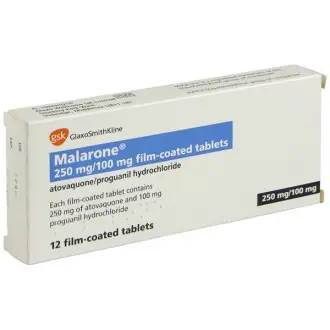
Images for illustrative purposes only
Looking for Next Day delivery?
Order before 15:30 on Monday to Friday for next day delivery
Malarone
Malarone tablets are a medication used to treat or prevent malaria, one of the world's deadliest infections, spread by an infected mosquito. These malaria tablets prevent the growth of P. falciparum parasites that cause malaria, and are often prescribed as a preventative measure when travelling to malaria-prevalent areas. To prevent malaria, it's suitable for adults and children who weigh more than 40 kg (about 6 st 4 lb). It combines two active ingredients, atovaquone and proguanil.
- Used to prevent malaria when travelling
- Contains the active ingredients atovaquone and proguanil
- The branded version of the cheaper generic Atovaquone/Proguanil
Malaria tablets treat malaria by preventing or destroying P. falciparum parasites present in red blood cells. The malaria parasite causes malaria, and once destroyed, is unable to infect the human body. Start a consultation with our online doctor to buy Malarone at Pharmacy Online.
Malarone is licensed to both treat and prevent malaria. We supply it for prevention only, to take when travelling to areas where malaria is common. If you think you have malaria, see a doctor urgently.
To prevent malaria, Malarone is taken 1 to 2 days prior to travelling to an area where malaria is more common. The medication is then taken daily during the time spent in that area, then for 7 days after leaving the malaria area.
Who should not take it
- Do not take it if you are allergic to atovaquone, proguanil or any of the other ingredients.
- Do not take it to prevent malaria if you have severe kidney disease.
Pregnancy and breastfeeding
Do not take Malarone during pregnancy unless your doctor recommends it. Do not breastfeed while taking Malarone, as the ingredients may pass into breast milk and may harm your baby.
Other medicines
Tell the prescriber if you take any of these, as they can lower the amount of atovaquone in your blood and make Malarone work less well: metoclopramide, tetracycline, rifampicin, rifabutin, efavirenz or certain boosted protease inhibitors used for HIV. Proguanil can strengthen the effect of warfarin and other medicines that stop blood clotting, and atovaquone can raise levels of etoposide, a cancer medicine.
As with any medication, there are possible risks of side effects when taking Malarone. Some of these are mild and mostly subside over time. Others may pose more serious risks and should be reported to your GP right away if experienced.
Please get in touch with a member of our team if you are concerned about any potential side effects that may occur when taking Malarone.
Very common side effects of Malarone (may affect more than 1 in 10 people):
- Headache
- Nausea
- Vomiting
- Abdominal pain
- Diarrhoea
Common side effects (may affect up to 1 in 10 people):
- Dizziness
- Disturbance to sleep
- Decreased appetite
- Fever
- Rash, which may be itchy
Malarone can sometimes lead to skin irritation, rashes and blisters. This can result in peeling skin, often occurring around the mouth. If you do begin to develop a rash, seek medical help immediately.
Sensitivity of the skin to sunlight (photosensitivity) has also been reported; its frequency is not known.
Should I take malaria tablets before travelling?
There are four common strains of malaria parasites, with some strains more prevalent in some areas than others. When considering these malaria tablets as a malaria prevention treatment before travelling, you should check which strain is the most common in the area first.
Malarone is suitable for preventing the P. falciparum parasite. It has no effect on the dormant liver stage of Plasmodium vivax or Plasmodium ovale, so these types of malaria can come back later. If you will have intense exposure to P. vivax or P. ovale, or you develop malaria caused by either, you will need an additional medicine.
There are multiple malaria prevention treatments available based on different strains. To find out which strain may be most common in your intended travel area, please visit the Government Fit For Travel website for the most up-to-date travel information.
How much Malarone do I need?
As Malarone is taken once daily for the duration of your trip, our online doctor will assess how much Malarone you need to ensure you are protected throughout your travels. It would be best if you took Malarone for the full length of time prescribed by your doctor.
As well, you should consider that Malarone is taken 1-2 days before travelling, and 7 days after travelling. For help with your Malarone prescription, start a consultation with our online doctor.
When to take Malarone?
The course of Malarone should begin 1 to 2 days prior to travelling to an area where malaria is more common. Once arrived, take Malarone for the duration of your stay, with one tablet taken once daily with food to effectively prevent malaria.
You should continue to take Malarone for 7 days after you leave the area in order to destroy any parasites present from an infected bite.
What do I do if I miss a Malarone dose?
If you miss a Malarone dose, take your next dose as soon as you remember, then continue your regular schedule of one tablet daily. Do not take more than one dose a day.
What if I am sick whilst taking Malarone?
In cases of vomiting within one hour of taking Malarone, you will need to repeat your dose in order to replace the lost medication. This will ensure you are adequately protected against malaria. Once you have repeated the dosage, continue to follow the course of Malarone as normal.
Can I drink alcohol whilst taking Malarone?
The possible side effect of dizziness may become worse in combination with alcohol. As alcohol can also increase the chances of vomiting, ensure that you are adequately protected with a repeated dose if vomiting occurs within one hour of the Malarone dosage.
You should stop drinking alcohol if vomiting or dizziness occurs.
Can Malarone make you tired?
Malarone can lower the number of red blood cells (anaemia), which can cause tiredness, headaches and shortness of breath. Tiredness can also be a sign of malaria. See a doctor immediately if you get symptoms such as high temperature, headache, shivering and tiredness after returning home, as the illness may not start until several days, weeks or even months after returning from abroad.
For a full list of possible side effects, read the Malarone patient information leaflet.
Leaflets
Before taking Malarone or any medicines, regardless of whether they are over-the-counter or prescription-only, it is essential always to read the patient information leaflet.

