
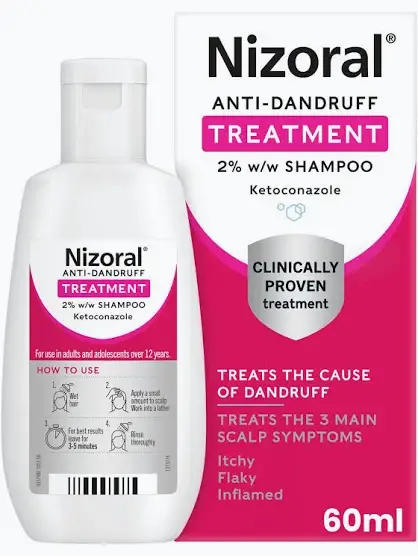
Images for illustrative purposes only
Looking for Next Day delivery?
Order before 15:30 on Monday to Friday for next day delivery
Nizoral Anti-Dandruff Shampoo
- Treats dandruff and helps stop it coming back, easing scalp redness and itching
- Twice a week for 2 to 4 weeks, then once every 1 to 2 weeks to keep your scalp clear
- Lather it into your scalp and leave it on for 3 to 5 minutes before you rinse
- The 60 ml bottle - the general sale pack, with no prescription needed
What Nizoral is for
Flakes on your shoulders, and an itchy scalp that will not settle? That is often dandruff. Nizoral Anti-Dandruff Shampoo treats it, and it helps stop it coming back.
It contains ketoconazole 2%, an antifungal. You use it twice a week at first. Once your scalp is clear, you keep it that way with one wash every 1 to 2 weeks.
It is a general sale medicine - add it to your basket, and ask our pharmacist if you need advice.
Is it right for you?
It may suit you if you are an adult or a young person over 12 and you have dandruff on your scalp.
Do not use it if you have ever had a bad reaction to ketoconazole or any of the other ingredients. They are listed in the Other tab.
It is not for children under 12.
- Using a steroid on your scalp? If you have been using a lotion or cream with a steroid in it (such as betamethasone or hydrocortisone) to control your dandruff, do not stop it all at once. Use it less and less over 2 to 3 weeks as you start Nizoral. This stops your scalp flaring up while Nizoral starts to work.
How to use it
- Wet your hair well.
- Put a small amount on your scalp and massage it into a lather.
- Leave the lather on your scalp for 3 to 5 minutes.
- Rinse well.
A palmful is usually enough for one wash.
How often
| How often | For how long | |
|---|---|---|
| To clear dandruff | Twice a week (every 3 or 4 days) | 2 to 4 weeks |
| To keep it away | Once every 1 to 2 weeks | For as long as you need it |
Do not use it more often than this. On the other days, wash your hair with your usual shampoo. If your hair is very thick, you can wash it with your usual shampoo first and then use Nizoral.
If you stop using it altogether, your dandruff may come back.
- Not clear after 4 weeks? If your scalp has not cleared within 4 weeks, speak to your doctor or pharmacist.
Use it only on your skin. Keep it out of your eyes. If any gets in, bathe them gently with water.
What it is and how it works
Yeasts called Malassezia live on everyone's skin. When you have dandruff, you seem to have more of them on your scalp. Ketoconazole is an antifungal that targets these yeasts.
It also treats the inflammation that comes with dandruff, which eases redness and itching.
When you use it on your scalp, no ketoconazole could be measured in the blood.
What it will not treat
This pack is for dandruff on your scalp. Do you have red, greasy or scaly patches on your face or body, or pale or brown patches on your skin after time in the sun? Ask our pharmacist which treatment fits. You can also look at our fungal infection treatments.
Like all medicines, Nizoral can cause side effects, although not everybody gets them. They are usually mild.
- Stop using it and talk to your doctor if you get a severe allergic reaction, such as swelling of your face, lips, tongue or throat.
Uncommon (less than 1 in 100 people):
- itching, irritation, blistering, or red, dry or tender skin where you use it, or a burning feeling
- inflamed hair follicles
- hair loss or changes in how your hair feels
- more tears than usual
- skin rash and dry skin
Rare (less than 1 in 1,000 people):
- a change in the way some things taste
- eye irritation
- acne
- skin inflammation (dermatitis)
- flaking skin
- reactions where you use it, including blistering and allergic reactions
- a general allergic reaction
Not known (how often cannot be estimated): changes in hair colour, and hives (nettle rash, or urticaria).
From the ingredients
It contains sodium lauryl ether sulfate, 24% of the shampoo. This may cause stinging or burning on your skin. It may also make skin reactions to other products worse, if you use them on the same area.
Reporting side effects
If you get any side effect, talk to your doctor, pharmacist or nurse. You can also report it to the MHRA through the Yellow Card scheme. Reporting helps everyone learn more about the safety of medicines.
What causes dandruff?
Yeasts called Malassezia. They live on everyone's skin, but if you have dandruff you seem to have more of them. Nizoral targets those yeasts, and it eases the redness and itching too.
How often should I use it?
Twice a week - about every 3 or 4 days - for 2 to 4 weeks. Once your scalp is clear, use it once every 1 to 2 weeks to stop the dandruff coming back.
How long do I leave it on?
3 to 5 minutes. Massage it into a lather on your scalp, wait, then rinse well.
Can I wash my hair on the other days?
Yes. Use your usual shampoo. Just do not use Nizoral more often than twice a week.
My hair is very thick. How do I use it?
Wash your hair with your usual shampoo first. Then use Nizoral, leave the lather on for 3 to 5 minutes, and rinse.
My dandruff has gone. Do I need to keep using it?
To keep it away, yes - once every 1 to 2 weeks. If you stop altogether, your dandruff may come back.
What if it has not cleared?
If your scalp has not cleared within 4 weeks, speak to your doctor or pharmacist.
I already use a steroid lotion on my scalp. Can I switch?
Yes, but slowly. Use the steroid less and less over 2 to 3 weeks while you start Nizoral. Stopping it all at once can make your scalp flare up. If you have questions about stopping your steroid, ask your doctor or pharmacist.
Can my child use it?
Not if they are under 12. It is for adults and young people over 12.
Can I use it if I am pregnant or breastfeeding?
Yes. You can use it if you are pregnant, think you might be, or are breastfeeding.
Can I use it with other products on my scalp?
It has no known interactions with other medicines. One of its ingredients, sodium lauryl ether sulfate, may make skin reactions to other products worse on the same area, though. Tell your pharmacist about anything else you use on your scalp.
What if it gets in my eyes?
Bathe them gently with water.
Does it contain any animal ingredients?
Yes. It contains laurdimonium hydrolysed animal collagen. It is made from animal collagen.
What if I forget to use it?
Use it as normal the next time you wash your hair.
What if someone swallows some?
Contact a doctor or your nearest A&E department. Take the leaflet and the bottle with you. Do not try to make them sick.
Will it affect my driving?
It is not likely to affect your ability to drive or use machines.
Ingredients
- Active ingredient: ketoconazole 2% w/w (20 mg in each gram)
- Other ingredients: sodium lauryl ether sulfate, disodium monolauryl ether sulphosuccinate, coconut fatty acid diethanolamide, laurdimonium hydrolysed animal collagen, macrogol 120 methyl glucose dioleate, sodium chloride, concentrated hydrochloric acid, imidurea, sodium hydroxide, erythrosine sodium (E127), purified water
- Contains 380 mg of sodium lauryl ether sulfate in each gram (24% w/w).
It is a pink liquid shampoo.
Pack
A 60 ml bottle.
Storage
- Do not store above 25°C.
- Keep it out of the sight and reach of children.
- Do not use it after the expiry date on the pack. The expiry date is the last day of that month.
- Do not throw medicines down the drain or in household rubbish. Ask your pharmacist how to get rid of any you no longer need.
Licence and maker
A general sale medicine (GSL), licence number PL 00240/0453. The licence holder and manufacturer is Thornton & Ross Ltd, Linthwaite, Huddersfield, HD7 5QH, UK.
Leaflet
Read the leaflet in the pack before you use it. The leaflet inside your pack is the one that applies to your shampoo.
Sources
The facts on this page come from these documents:
- Nizoral Anti-Dandruff Treatment 2% w/w Shampoo - Summary of Product Characteristics (emc) - Thornton & Ross Ltd, revised 17 August 2023
- Nizoral Anti-Dandruff Treatment 2% w/w Shampoo - patient information leaflet (emc) - Thornton & Ross Ltd, revised January 2024
- MHRA Yellow Card scheme - how to report a side effect
Last checked against these sources: 12 November 2026.

