
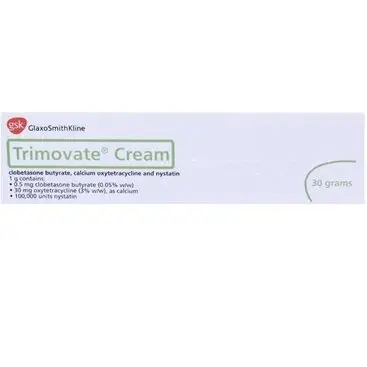
Images for illustrative purposes only
Looking for Next Day delivery?
Order before 15:30 on Monday to Friday for next day delivery
Trimovate Cream
Trimovate cream is a triple-action treatment for inflamed skin conditions where a bacterial or fungal infection is present or likely, such as eczema (atopic and seborrhoeic dermatitis), nappy rash, intertrigo and anogenital itching. It contains three active ingredients: a steroid called Clobetasone butyrate 0.05%, an antibiotic medicine called Oxytetracycline 3.0%, and an antifungal medication called Nystatin 100,000 units per gram. These three active ingredients work in different ways to help reduce skin inflammation, itchy skin and skin infections.
- Three active ingredients
- Fast-acting topical corticosteroid
- Short-term use only
Buy Trimovate Cream Online
Trimovate is a triple combination cream used to treat flare-ups of conditions including eczema and dermatitis.
Its three active ingredients work in combination to treat inflammatory skin conditions, providing relief from both bacterial infections and fungal skin infections.
When to Use Trimovate Cream?
Trimovate Cream is only suitable if a healthcare professional recommends that you use it. The medication is best for treating the following conditions:
- Intertrigo: Your doctor or pharmacist may prescribe the cream for intertrigo rashes.
- Eczema: If you have eczema and your healthcare professional suspects a fungal or bacterial infection, they may prescribe Trimovate.
- Nappy Rash: Most forms of nappy rash are suitable for mild creams, but Trimovate may be suitable where there is an infection sensitive to its ingredients.
Please note that you should only use the cream as a short-term treatment, as using corticosteroids long-term can damage the skin.
How to Use Trimovate Cream?
When using Trimovate cream, please follow these instructions:
- Wash your hands before applying the cream and ensure the affected area is clean and dry. Wash your hands again after applying, unless your hands are the area being treated.
- Squeeze the tube and place a small amount of cream onto your fingertip.
- Rub a thin and even layer into the affected area, and avoid using too much cream.
In most cases, you'll apply Trimovate Cream up to twice daily, depending on the prescriber's instructions.
When to Avoid Using Trimovate?
Trimovate is a powerful cream that may not be suitable for some people. You should avoid applying it if any of the following apply:
- Rosacea and Acne: Do not use Trimovate if you have rosacea or acne, as it could make them worse. If you're experiencing either skin problem, we have a range of suitable treatments available.
- Allergies: If you are sensitive to or allergic to any ingredients in Trimovate Cream, please avoid it and ask a prescriber for a suitable alternative.
- Viral Infections: Do not use Trimovate on viral skin infections such as cold sores, herpes or chickenpox, as it could make them worse. Trimovate Cream is only suitable for fungal and bacterial infections.
- Fungal or Bacterial Infections: It's also essential to remember that Trimovate Cream is only suitable for inflammatory skin conditions worsened by a bacterial or fungal infection. Do not use it to treat skin infections such as impetigo, ringworm, athlete's foot or thrush, as it could make them worse.
- Perioral Dermatitis: Do not use Trimovate if you have perioral dermatitis (a red, bumpy rash around the mouth), as it could make it worse.
- Itchy Skin Without Inflammation: Do not use Trimovate on itchy skin that is not inflamed.
- Certain Bacterial Infections: Do not use Trimovate on skin infections caused by MRSA, Pseudomonas, Proteus, Serratia, Acinetobacter or Streptococcus B bacteria.
Precautions for Trimovate Cream
It's also important to avoid using Trimovate on the face, unless your doctor or pharmacist expressly advises you to do so. Steroids can lead to skin thinning and cause permanent aesthetic damage.
Do not smoke or go near naked flames while using Trimovate - risk of severe burns. Fabric (clothing, bedding, dressings etc.) that has been in contact with the cream burns more easily and is a serious fire hazard. Washing clothing and bedding may reduce product build-up but not totally remove it.
If you are pregnant or breastfeeding, think you may be pregnant or are planning to have a baby, ask your doctor or pharmacist for advice before using Trimovate. It should only be used in pregnancy or while breastfeeding if the expected benefit to you outweighs the risk to the baby, using the smallest amount for the shortest time. If you use it while breastfeeding, do not apply it near your nipple.
Ingredients for Trimovate Cream
Trimovate is a "triple-action" formula with three key ingredients:
- Oxytetracycline (3% w/w): An antibiotic that prevents bacteria from growing and reproducing.
- Clobetasone Butyrate (0.05% w/w): A moderate-strength corticosteroid that reduces swelling, itching and inflammation.
- Nystatin: An antifungal treatment that is particularly beneficial for fungal infections like Candida.
Inactive Ingredients:
- Titanium dioxide
- Glyceryl monostearate
- Soft paraffin white
- Cetostearyl alcohol
- Dimeticone 20
- Polyoxyl 40 stearate
- Sodium metabisulphite
- Disodium hydrogen phosphate
- Glycerol
- Chlorocresol
- Purified water
- Sodium acid phosphate
Side Effects of Trimovate Cream
The most commonly reported side effect of Trimovate cream is small, widened blood vessels on the skin (telangiectasia). How often the other side effects below happen is not known.
Trimovate cream may cause local skin reactions, including skin irritation, inflamed skin, rash, thin skin, and slight burning sensations.
Trimovate cream may also cause excessive hair growth, increased body hair, or worsening symptoms.
Some patients may also experience opportunistic skin infections.
Can I use Trimovate cream on open cuts and sores?
It is not recommended to use Trimovate cream on broken skin. If there are open cuts in the skin, Trimovate cream can cause extreme irritation in these areas, which is why we do not recommend using it on sensitive areas of skin.
How often can I apply Trimovate cream?
A thin layer of Trimovate cream can be applied once or twice a day, for up to 7 days. Do not use it for more than 7 days unless your doctor tells you to.
Take care not to get cream on the surrounding healthy skin as the topical corticosteroid can cause skin thinning.
Once symptoms have reduced, stop using the treatment, or switch to less potent steroid creams.
Trimovate cream is not suitable for continuous treatment. If you haven't seen any improvement in your skin condition, or symptoms worsen, your topical medication should be reviewed by your doctor or pharmacist.
Can I use my regular emollient cream while using Trimovate cream?
Yes, absolutely. We recommend you keep up with your emollient treatment whilst using Trimovate as the skin will benefit from added moisturising to combat dry skin conditions.
What should I do if I miss an application of Trimovate cream?
If you miss a Trimovate application, apply it once you remember, then carry on as normal.
Can Trimovate cream interact with other medications?
Some medicines can affect how Trimovate works. Medicines such as ritonavir (used to treat HIV infection) and itraconazole (used to treat fungal infections) can increase the amount of steroid that gets into your body. Tell your doctor or pharmacist about any other medicines you are using. The cream can also interact with other topical treatments, so it's best to exercise caution and avoid combining Trimovate with other corticosteroids.
Can I use Trimovate cream on a confirmed skin infection caused by a bacterial or fungal infection?
Yes. Trimovate treats several skin conditions with additional bacterial or fungal infection. It is most commonly prescribed for:
- eczema (atopic, seborrhoeic & contact dermatitis)
- nappy rash
- intertrigo
- anogenital pruritus
When used correctly, you'll find it not only treats infections but also reduces inflammation and other uncomfortable symptoms.
Leaflets
Before taking any medicines, whether they are over-the-counter or prescription-only, it is essential to always read the patient information leaflet. If you have any questions or need advice, please get in touch with our dedicated pharmacy team today.

