
How to Get Rid of Acne: A Pharmacist's Self-Care Guide
Pharmacist advice on how to get rid of acne at home: a simple skincare routine, using over-the-counter products, acne myths and when to get help.
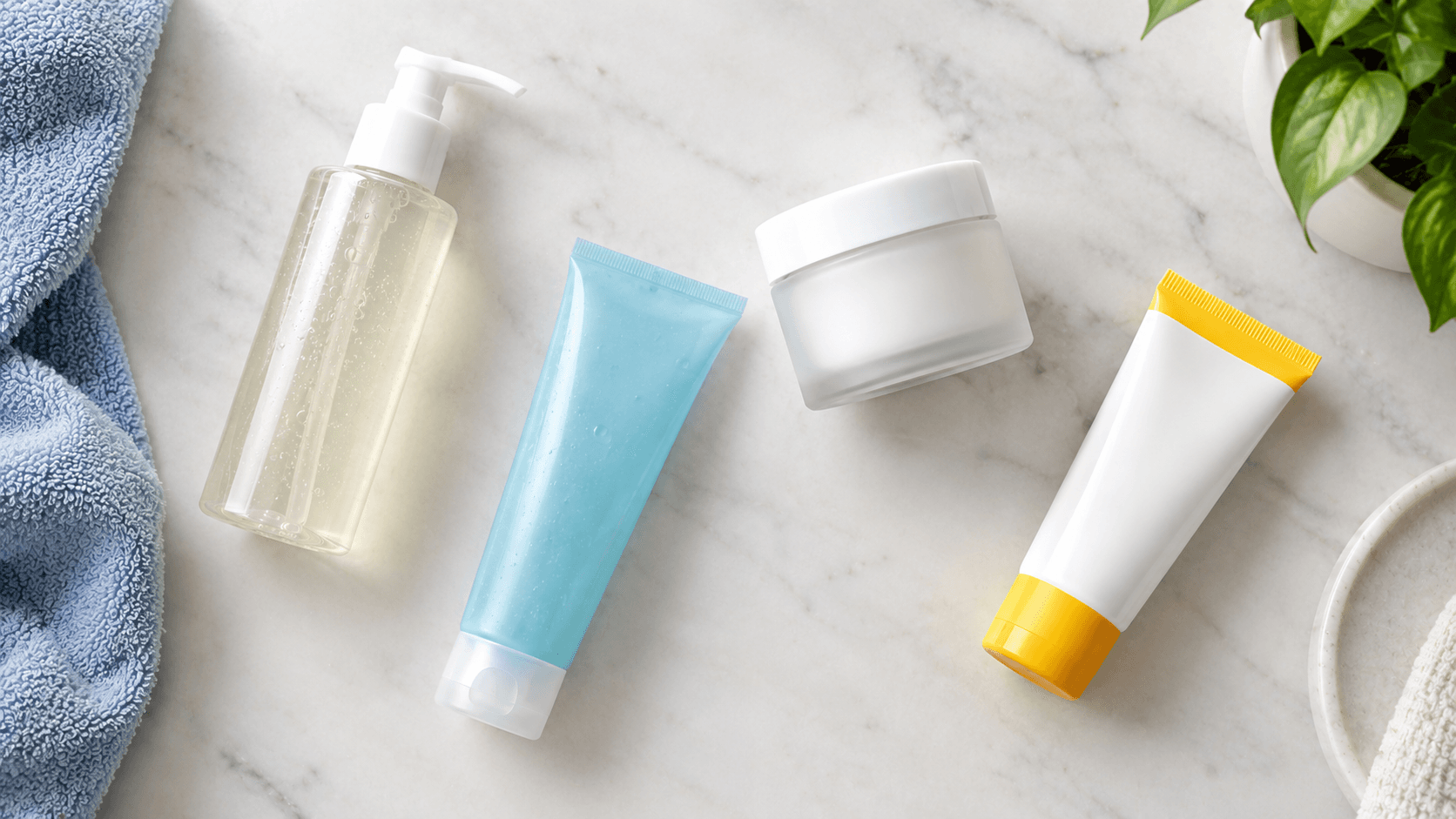
Acne is one of the most common skin conditions in the world, affecting around 85% of people aged 12 to 25 to some degree[1]. For some people, it carries on into adulthood or appears for the first time in their late twenties or later[2].
Despite how common the condition is, the good news is that mild acne can improve with some changes to your daily routine and a suitable product your pharmacist can help you choose. However, there is no ‘overnight’ fix for acne and some popular or viral tips and tricks you may have seen can make things worse.
This guide is built around the advice that our pharmacists give every day: work out how severe your acne is, follow a simple routine that suits acne-prone skin and learn how to use over-the-counter products correctly.
Step 1: Check how severe your acne is
Managing acne effectively depends on understanding the severity of it, the NHS describes three broad levels of severity to use as a guide (not a diagnosis). See the table below for an overview:
| Severity | What you might see | What usually helps |
|---|---|---|
| Mild | Mostly whiteheads and blackheads, with a few red spots or spots with a white head | Good daily skincare plus an over-the-counter product, used consistently for up to 12 weeks |
| Moderate | Whiteheads and blackheads over a wider area, with many red or pus-filled spots | Speak to a pharmacist or doctor. Self-care still helps, but you are likely to need prescription treatment |
| Severe | Lots of large, painful spots, lumps under the skin (nodules) or cysts, sometimes with scarring | See a doctor promptly. Self-care alone will not clear severe acne and early treatment reduces the risk of scarring |
If your acne sounds moderate or severe, we offer an online acne treatment service.
Step 2: Make sure it is actually acne
There are a few common skin conditions which look like acne but require a different approach to treatment. This is why it is important to fully understand the symptoms you are dealing with before spending weeks using the wrong product or treatment.
- Rosacea causes redness across the nose, cheeks, forehead and chin, often with small red or pink bumps[3]. It tends to start later in adulthood, flushes easily and does not usually cause blackheads or whiteheads. Many acne products can irritate Rosacea.
- Fungal acne (Malassezia folliculitis) is caused by yeast rather than bacteria. It usually looks like lots of small, same-sized, itchy bumps on the chest, upper back or forehead, without blackheads or whiteheads [4]. Standard acne products will not clear it.
- Folliculitis is inflammation of hair follicles, often after shaving, waxing or sweating, and can look like a rash of small red or white-topped spots.
If you are unsure, a pharmacist or GP can take a look and advise you further.
Step 3: Follow a simple routine for acne-prone skin
Acne is not caused by having a dirty face, despite common misconceptions about the condition and hygiene. Acne develops beneath the skin, inside hair follicles which have become blocked[5].
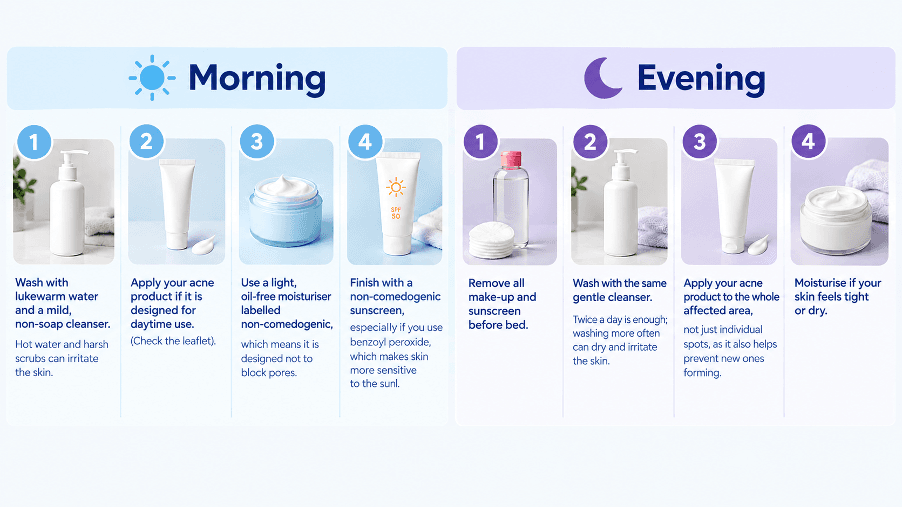
Therefore, scrubbing your skin harder or for longer will not clear acne and usually makes your skin sore and increases inflammation. A short, gentle and consistent routine is more effective than a complex or long one. Below is our pharmacist’s version of a simple routine for mild to moderate acne-prone skin:
Morning
- Wash with lukewarm water and a mild, non-soap cleanser. Hot water and harsh scrubs can irritate the skin[5][6].
- Apply your acne product if it is designed for daytime use (check the leaflet).
- Use a light, oil-free moisturiser labelled non-comedogenic, which means it is designed not to block pores.
- Finish with a non-comedogenic sunscreen, especially if you use benzoyl peroxide, which makes skin more sensitive to the sun[7].
Evening
- Remove all make-up and sunscreen before bed[6].
- Wash with the same gentle cleanser. Twice a day is enough; washing more often can dry and irritate the skin[5].
- Apply your acne product to the whole affected area, not just individual spots, as it also helps prevent new ones forming.
- Moisturise if your skin feels tight or dry.
Pharmacist tip: Oily skin still needs a moisturiser. Acne treatments can dry out your skin, and dry, irritated skin makes it harder to keep using them long enough to work.
Step 4: Use over-the-counter products properly
For mild acne, one of our pharmacists will usually suggest a product containing one of these active ingredients.
Benzoyl peroxide
Benzoyl peroxide is an effective treatment for mild acne, as it reduces bacteria and helps unblock pores. You can find it as the active ingredient in several washes, gels and creams. It usually starts to work within about 4 weeks[7], but most acne treatments take 12 weeks or more to have their full effect[2]. To get the best from it[7]:
- Start with the lowest strength and use it once daily to begin with, building up to twice a day if your skin is tolerating it.
- Expect some dryness, redness or stinging in the first few days. This should settle; if it doesn’t, use it less often or speak to your prescriber.
- Protect your fabrics, remember that Benzoyl peroxide can bleach towels, pillowcases, clothing and hair.
- Wear sunscreen and avoid sunbeds, as benzoyl peroxide makes skin more sensitive to sunlight.
- Try a rinse-off version if you have sensitive skin as people find these options gentler.
Salicylic acid
Salicylic acid is a good option if your acne is mostly blackheads and whiteheads. It helps loosen and clear the dead skin cells that build up inside pores, which stops them from clogging and helps break down existing blackheads and whiteheads[9]. You can find it in lots of everyday skincare, including cleansers, toners and spot treatments. To get the best from it:
- Start slowly. Use it once a day to begin with and build up gradually, as it can be drying.
- Expect some mild stinging, especially on broken or sensitive skin or with higher-strength products[9]. If your skin becomes sore or very dry, use it less often.
- Pick one format. A cleanser and a toner both containing salicylic acid can be too much. Choose one product and use it consistently.
- Pair it with a light moisturiser to keep dryness under control.
- Check the label first if you are allergic to aspirin, or if you are pregnant or breastfeeding. Speak to a pharmacist if you are unsure.
Introducing new products - pharmacist’s tip:
Add one new product at a time and give it a few weeks before adding another. If your skin reacts, you will know which product caused it. Layering several strong products at once is one of the most common reasons we see skin become red, peeling and sore.
Give it time: what to expect week by week
The main piece of advice we can give you when it comes to using acne products is to give it time to work!
Most acne products start to help within a few weeks, but it can take 12 weeks or more to see a clear difference[2][7]. Stopping too early or using products inconsistently are some of the main reasons people think a treatment has not worked. The below table provides an overview of timeframes and what is typical when treating acne:
| Timeframe | What is typical |
|---|---|
| Weeks 1 to 2 | Your skin may feel drier or look a little red as it adjusts. New spots can still appear, as they were already forming under the skin. |
| Weeks 3 to 6 | Irritation usually settles. Many people start to notice fewer new spots. |
| Weeks 6 to 12 | This is when a clear improvement is expected. If there is no improvement by 12 weeks, speak to one of our pharmacists or your doctor [7]. |
| Once clear | Keep up your routine - consistency is key. Acne often returns if you stop completely, so many people continue a product a few times a week to keep skin clear. |
Acne myths debunked: what does and does not work
- "Toothpaste dries out spots." Toothpaste is very irritating to the skin and can cause discolouration, especially on darker skin tones[10]. A proper spot treatment works better.
- "Acne is caused by poor hygiene." It is not. Acne starts beneath the skin, and over-washing can make it worse[5][10].
- "The sun clears up acne." There is no conclusive evidence that sunlight helps acne[11], and UV exposure increases the risk of skin damage and skin cancer[12].
- "Chocolate causes acne." There is no strong evidence linking chocolate to acne[10]. However, diets high in sugary and refined foods (high glycaemic index foods) may play a role for some people [11]. If you notice a pattern with certain foods, it is reasonable to cut back and see if it helps.
- "You can catch acne." You cannot pass acne on to other people, it is not contagious[11].
- "Squeezing gets rid of spots faster." Squeezing and picking push inflammation deeper and often result in scarring[5][10].
Make-up, sunscreen and exercise
You don’t need to stop wearing make-up if you struggle with acne but the types of products you use matter more because you do. Choose products with formulas that are labelled as non-comedogenic or oil-free, so they don’t block your pores[6]. We recommend using mineral powders and light, water-based foundations rather than heavy creams as acne-prone skin will tolerate these types of products better.
Sunscreen is important for all skin types but even more so if you use an acne product which makes your skin more sensitive to sunlight, for example, Acnecide because it contains benzoyl peroxide. Choose a light, non-comedogenic sunscreen, they are often labelled for oily or blemish-prone skin[6].
If you exercise regularly, shower as soon as you can afterwards so sweat does not sit on your skin and wear loose, breathable clothing[6]. Be aware that tight straps, helmets and face coverings that rub the same spot repeatedly can also trigger breakouts.
Acne on your back and chest
Your back, chest and shoulders have lots of oil glands, so acne there is common. The same approach applies: gentle washing, non-comedogenic body products and consistency. Benzoyl peroxide body washes are practical for hard-to-reach areas but keep in mind that they can bleach towels and clothing[7].
Acne during pregnancy
Hormonal changes in pregnancy can trigger acne or make it worse[6]. Gentle skincare is safe and is the best place to start. Some acne medicines are not suitable during pregnancy, including retinoid creams and some tablets, because of the risk of harm to the baby[14]. Benzoyl peroxide can typically be used, but check with a pharmacist, midwife or doctor first[7].
Always tell your pharmacist or doctor if you are pregnant, trying for a baby or breastfeeding before starting any acne product.
Managing acne scars
After a spot heals, it often leaves a flat red, purple or brown mark. These are not true scars and usually fade over several months. Daily sunscreen helps stop them getting darker.
True scars, such as small pits or dents, are more likely after deep, inflamed spots and after picking[5]. The best way to prevent scarring is to get acne under control early and no picking or popping.
Acne and your mental health
Acne can affect how you feel about yourself. It can cause anxiety and stress, and for some people it leads to low mood or low self-esteem[5][6]. This is not vanity, and you do not have to put up with it. If acne is affecting your mood or confidence, speak to a pharmacist or your GP. The charity Acne Support also has practical advice and support[15].
If you are feeling very low, or having thoughts of harming yourself, speak to your GP urgently or call NHS 111. You can also call Samaritans free on 116 123.
When self-care is not enough
Speak to a pharmacist or doctor if:
- your acne has not improved after around 12 weeks of using an over-the-counter product properly[7]
- your acne is moderate or severe, or you have painful lumps or cysts [6]
- your acne is leaving marks or scars
- your acne is affecting your mood or confidence
- you are not sure whether it is acne at all
Prescription medicines work in different ways from over-the-counter products and can be more effective for moderate acne.
Need advice?
If you are not sure where to start, our pharmacists are happy to help you choose a suitable product or work out whether you need something stronger. Get in touch or, if you think you need prescription treatment, visit our acne treatment page.
Frequently Asked Questions
What causes back acne?
There are many factors which could cause back acne. The first is that your back has lots of oil glands so getting acne here is quite common. This area of your body is also exposed to a lot of friction and sweat. Tight tops, rucksack straps and sports kit rub the skin and trap heat and sweat, which can trigger breakouts[16], showering soon after exercise and wearing loose, breathable fabrics can help with this[6][13].
Some people also notice acne on their back and chest after starting whey protein supplements[17]. Benzoyl peroxide body washes are a practical option for hard-to-reach areas, but remember that they can bleach towels and clothing[7].
Does dairy cause acne?
A large review of studies found that people who consumed more dairy, especially milk, were slightly more likely to have acne, although the authors say the results should be interpreted with caution[18]. These studies show an association, not proof that dairy causes acne.
Acne Support, from the British Association of Dermatologists, says there is observational and anecdotal evidence that foods and drinks that cause big rises in blood sugar, such as sugars, refined carbohydrates and dairy, may be linked to acne[10]. However, NICE advises that there is not enough evidence to support specific diets for treating acne[14].
If you notice a pattern, try cutting back for a few weeks to see whether it helps. Speak to a pharmacist or GP before cutting dairy out completely, because it is an important source of calcium.
Does whey protein cause acne?
Whey protein may cause acne for some people. Small studies, mostly in gym-goers and bodybuilders, have linked whey protein supplements with new or worse acne, especially on the back and chest[17]. However, the evidence is limited. If you think whey is triggering breakouts, try stopping it or switching to a plant-based protein for a few weeks to see if your skin improves.
Does creatine cause acne?
There is no good evidence that creatine causes acne. The idea mostly comes from one small study in which creatine raised levels of DHT, a hormone made from testosterone, and later research has not confirmed that finding[19]. Testosterone and DHT can make the skin's oil glands bigger and increase how much oil they produce[24], which is why the theory spread. If you get breakouts while taking creatine, check whether your supplements also contain whey[17], and shower soon after training.
Does vaping cause acne?
There is very little research on vaping and acne, so we don't know whether vaping causes it. Smoking has been linked to acne in older people[11], and most vapes contain nicotine, but it isn't clear whether vaping has the same effect. If you want help to stop smoking or vaping, our pharmacists can help.
Are sunbeds good for acne?
No. Sunbeds and sunbathing are not good for acne[11]. Short bursts of UV may calm inflammation a little, but longer exposure can encourage blocked pores[10].
Sunbeds also give off UV radiation, which damages the DNA in skin cells and can lead to skin cancer, including melanoma[12]. If you use benzoyl peroxide, avoid sunbeds completely, because it makes your skin more sensitive to sunlight[7].
Is salicylic acid good for acne?
Salicylic acid is good for acne if your acne is mostly blackheads and whiteheads. Salicylic acid slows the shedding of skin cells inside pores, which stops them clogging, and it helps break down existing blackheads and whiteheads[9]. Salicylic acid is less likely to help deep, painful spots or cysts. For those, speak to a pharmacist or doctor[6].
Start by using it once a day, because it can be drying and may sting a little, especially on broken skin[9]. If you are pregnant or breastfeeding, check with a pharmacist first[9]. See Step 4 above for how to use it.
Does Sudocrem help acne?
Sudocrem is licensed to treat acne, as well as nappy rash, eczema and minor wounds[20]. It contains zinc oxide and mild antiseptic ingredients and is applied in a thin layer. It is a thick barrier cream, so many people find a lighter acne product easier to use every day across the whole affected area. Always read the label; it contains lanolin[20].
For acne that keeps coming back, a dedicated acne product applied to the whole affected area every day is usually more effective.
Does lymecycline help acne?
Lymecycline is a prescription-only antibiotic that kills the bacteria that cause acne[21]. It is used for moderate to severe acne, usually together with a cream or gel rather than on its own[2]. Some people see improvement within a week, but it can take several weeks to work fully [21], and courses usually last 3 to 6 months[2]. It is not usually needed for mild acne, which often improves with over-the-counter products. If your acne is moderate or severe, speak to a pharmacist or doctor about prescription options.
Does retinol help with acne scars?
It depends on the type of mark. Flat red, purple or brown marks left after spots aren't true scars. Retinoids can help dark marks fade faster[22]. Retinol is a milder, cosmetic form of retinoid, so expect slower and gentler results. Daily sunscreen also helps stop these marks getting darker.
Retinol is unlikely to help true scars, such as ice-pick or boxcar scars (small pits or dents in the skin)[11][23]. These usually need treatments from a qualified practitioner, such as chemical peels, microneedling, laser treatment or fillers[23]. If you are pregnant or trying for a baby, speak to a pharmacist before using retinol, because retinoid medicines are not suitable during pregnancy[14].
References
- [1]
Lynn DD, Umari T, Dunnick CA, Dellavalle RP. The epidemiology of acne vulgaris in late adolescence. Adolesc Health Med Ther [Internet]. 2016;7:13–25. Available from: https://www.dovepress.com/the-epidemiology-of-acne-vulgaris-in-late-adolescence-peer-reviewed-fulltext-article-AHMT [Accessed 7 October 2026]
- [2]
British Association of Dermatologists. Acne: patient information leaflet [Internet]. London: BAD; 2024. Available from: https://cdn.bad.org.uk/uploads/2021/11/11141629/Acne-PIL-July-2024-.pdf [Accessed 7 October 2026]
- [3]
NHS. Rosacea [Internet]. London: NHS; 2023. Available from: https://www.nhs.uk/conditions/rosacea/ [Accessed 7 October 2026]
- [4]
DermNet. Malassezia folliculitis [Internet]. New Zealand: DermNet; 2020. Available from: https://dermnetnz.org/topics/malassezia-folliculitis [Accessed 7 October 2026]
- [5]
NHS inform. Acne [Internet]. Scotland: NHS 24; 2026. Available from: https://www.nhsinform.scot/illnesses-and-conditions/skin/skin-conditions/acne [Accessed 7 October 2026]
- [6]
NHS. Acne [Internet]. London: NHS; 2026. Available from: https://www.nhs.uk/conditions/acne/ [Accessed 7 October 2026]
- [7]
NHS. Benzoyl peroxide [Internet]. London: NHS; 2026. Available from: https://www.nhs.uk/medicines/benzoyl-peroxide/ [Accessed 7 October 2026]
- [8]
DermNet. Azelaic acid [Internet]. New Zealand: DermNet; 2022. Available from: https://dermnetnz.org/topics/azelaic-acid [Accessed 7 October 2026]
- [9]
DermNet. Salicylic acid [Internet]. New Zealand: DermNet; 2024. Available from: https://dermnetnz.org/topics/salicylic-acid [Accessed 7 October 2026]
- [10]
Acne Support (British Association of Dermatologists). Acne myths [Internet]. London: BAD; 2018. Available from: https://www.acnesupport.org.uk/myths/ [Accessed 7 October 2026]
- [11]
Primary Care Dermatology Society. Acne vulgaris: patient information leaflet [Internet]. UK: PCDS; 2025. Available from: https://www.pcds.org.uk/patient-info-leaflets/acne-vulgaris [Accessed 7 October 2026]
- [12]
Cancer Research UK. How do sunbeds cause skin cancer? [Internet]. London: CRUK; 2026. Available from: https://www.cancerresearchuk.org/about-cancer/causes-of-cancer/sun-uv-and-cancer/how-do-sunbeds-cause-skin-cancer [Accessed 7 October 2026]
- [13]
Health Service Executive. Acne: self-management [Internet]. Dublin: HSE; 2023. Available from: https://www2.hse.ie/conditions/acne/self-management/ [Accessed 7 October 2026]
- [14]
National Institute for Health and Care Excellence. Acne vulgaris: management (NG198) [Internet]. London: NICE; 2021 [updated 2026 Aug 3]. Available from: https://www.nice.org.uk/guidance/ng198/chapter/Recommendations [Accessed 7 October 2026]
- [15]
Acne Support (British Association of Dermatologists). Emotional support [Internet]. London: BAD; 2026. Available from: https://www.acnesupport.org.uk/emotional-support/ [Accessed 7 October 2026]
- [16]
Acne Support (British Association of Dermatologists). Prevention [Internet]. London: BAD; 2026. Available from: https://www.acnesupport.org.uk/prevention/ [Accessed 7 October 2026]
- [17]
Cengiz FP, Cevirgen Cemil B, Emiroglu N, Gulsel Bahali A, Onsun N. Acne located on the trunk, whey protein supplementation: is there any association? Health Promot Perspect [Internet]. 2017;7(2):106–8. Available from: https://pubmed.ncbi.nlm.nih.gov/28326292/ [Accessed 7 October 2026]
- [18]
Juhl CR, Bergholdt HKM, Miller IM, Jemec GBE, Kanters JK, Ellervik C. Dairy intake and acne vulgaris: a systematic review and meta-analysis of 78,529 children, adolescents, and young adults. Nutrients [Internet]. 2018;10(8):1049. Available from: https://www.mdpi.com/2072-6643/10/8/1049 [Accessed 7 October 2026]
- [19]
Antonio J, Candow DG, Forbes SC, Gualano B, Jagim AR, Kreider RB, et al. Common questions and misconceptions about creatine supplementation: what does the scientific evidence really show? J Int Soc Sports Nutr [Internet]. 2021;18(1):13. Available from: https://pmc.ncbi.nlm.nih.gov/articles/PMC7871530/ [Accessed 7 October 2026]
- [20]
Electronic medicines compendium. Sudocrem Antiseptic Healing Cream: summary of product characteristics [Internet]. UK: Datapharm; 2026. Available from: https://www.medicines.org.uk/emc/product/8860/smpc [Accessed 7 October 2026]
- [21]
NHS. About lymecycline [Internet]. London: NHS; 2026. Available from: https://www.nhs.uk/medicines/lymecycline/about-lymecycline/ [Accessed 7 October 2026]
- [22]
Davis EC, Callender VD. Postinflammatory hyperpigmentation: a review of the epidemiology, clinical features, and treatment options in skin of color. J Clin Aesthet Dermatol [Internet]. 2010;3(7):20–31. Available from: https://pmc.ncbi.nlm.nih.gov/articles/PMC2921758/ [Accessed 7 October 2026]
- [23]
DermNet. Acne scarring [Internet]. New Zealand: DermNet; 2026. Available from: https://dermnetnz.org/topics/acne-scarring [Accessed 7 October 2026]
- [24]
Acne Support (British Association of Dermatologists). DNA and hormones [Internet]. London: BAD; 2018. Available from: https://www.acnesupport.org.uk/cause/dna-and-hormones/ [Accessed 7 October 2026]
Related products


Related articles

How Lymecycline tablets can help with Acne
Acne affects more than 80% of people at some point in their life, so it’s no surprise that there are such a variety of treatments to choose from.
Eczema and Psoriasis: The Ultimate Guide
Irritating skin conditions are some of the most common ailments for adults and children. Dry or itchy skin can become painful and hard to manage and in some cases can become infected, causing more issues.

Winter Skincare Tips for Healthy Winter Skin
Winter can be particularly harsh on the skin, bringing cold, dry air that can leave skin red and irritated.