
Wegovy vs Ozempic: Same Drug, Different Purposes
Wegovy and Ozempic both contain semaglutide but they're licensed for different purposes in the UK. Find out the key differences and which you can access.
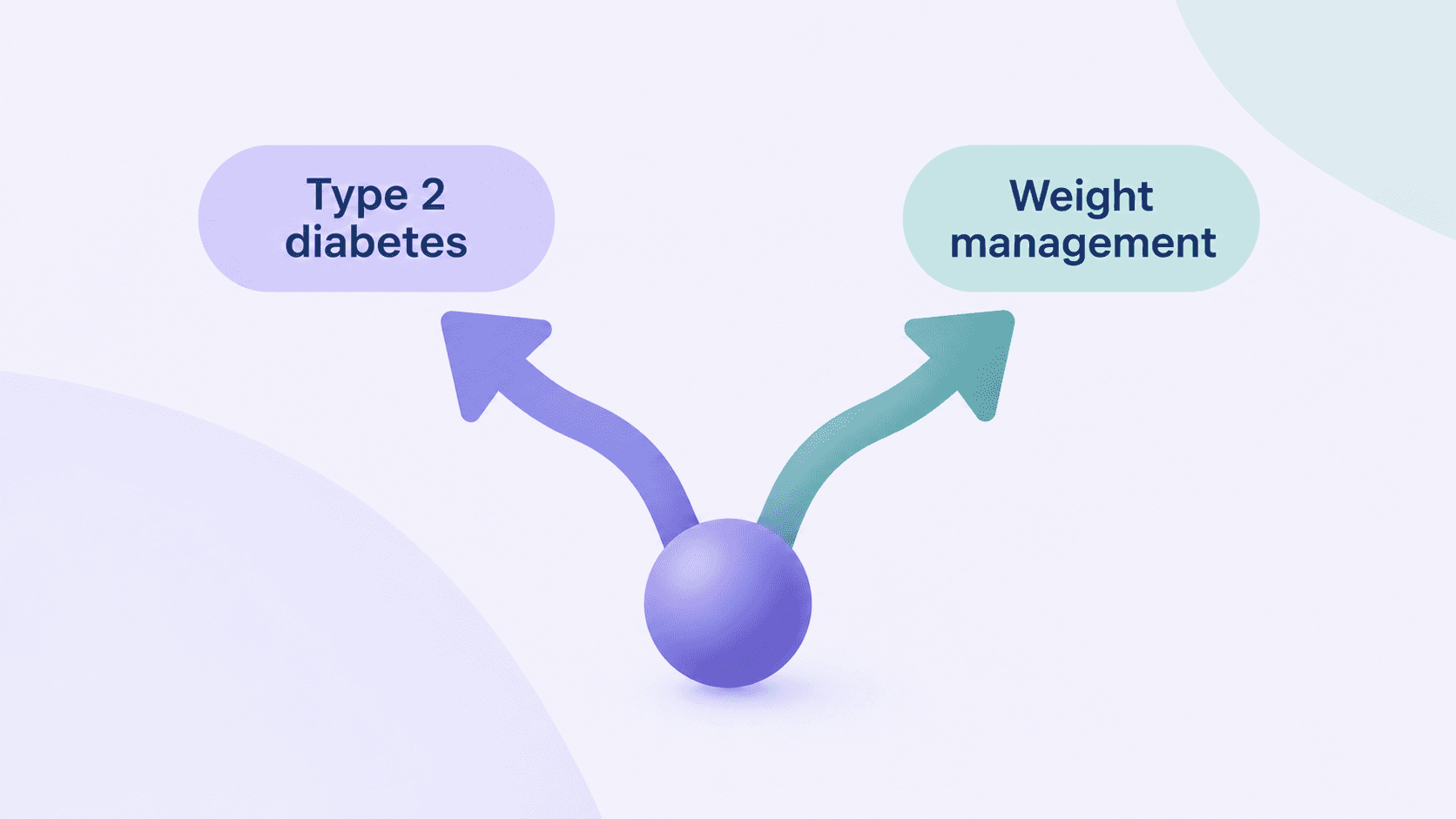
Wegovy and Ozempic both contain the same active ingredient: semaglutide. Developed by Novo Nordisk, they work in the same way, but there's an important difference to be aware of: semaglutide under the brand name Ozempic is licensed to treat type 2 diabetes, while Wegovy is for weight management[1][2].
While both treatments can support weight loss, they have different doses, schedules, and eligibility requirements[1][2][3]. Wegovy has a higher dose threshold, so it can support people struggling with weight management[1][2].
You can't get Ozempic through the NHS for weight loss and UK guidance recommends against prescribing it off-label for weight management[4][5].
In this guide, we'll explore Wegovy vs Ozempic in depth, including how they work, NHS availability, potential side effects, and whether you can switch between them.
Wegovy vs Ozempic
The main difference between the two medications is their purpose. Ozempic is for type 2 diabetes, while Wegovy is for weight management[1][2].
| Wegovy (Semaglutide) | Ozempic (Semaglutide | |
|---|---|---|
| Active ingredient | Semaglutide | Semaglutide |
| Manufacturer | Novo Nordisk | Novo Nordisk |
| UK Indication | Weight management; cardiovascular risk reduction; MASH | Type 2 diabetes |
| MHRA licensed | Yes (weight management; cardiovascular risk reduction; MASH: July 2026)[6] | Yes (type 2 diabetes)[2] |
| NICE recommended | Yes - TA875 (weight management)[3]; cardiovascular use (2026)[7] | Yes, for some people with type 2 diabetes (NICE NG28)[22] |
| Maximum dose | 7.2mg weekly (MHRA January 2026)[8] | 2mg weekly |
| Starting dose | 0.25mg weekly | 0.25mg weekly |
| Available on NHS | Via specialist weight management services[3]; wider NHS access for cardiovascular risk reduction[7] | Yes, for type 2 diabetes[4] |
| Available privately for weight loss | Yes | Off-label only; DHSC guidance discourages this[5] |
| Also available as a pill | Yes - Wegovy pill (MHRA June 2026)[9] | No (Rybelsus is oral semaglutide for diabetes)[10] |
| Pen device | FlexTouch (0.25–2.4mg)[1]; single-dose pen (7.2 mg)[21] | Multi-dose pre-filled pen (0.25 mg, 0.5 mg, 1 mg and 2 mg pens)[2] |
Are Wegovy and Ozempic the same drug?
Ozempic and Wegovy are technically the same drug in terms of formulation, as both contain semaglutide, which is a GLP-1 (glucagon-like peptide-1) receptor agonist[1][2]. Semaglutide mimics the effects of GLP-1, which is a hormone that regulates blood sugar levels and appetite after eating[1][6].
Semaglutide works in the following ways:
- Regulating Appetite: It acts on brain signals involved in hunger and fullness, increasing satiety after smaller meals[1][4].
- Slowing Digestion: The medication slows stomach emptying, which can make you feel fuller after meals[1][4].
- Insulin production: When blood glucose levels are elevated, semaglutide stimulates insulin release[1].
- Glucagon Regulation: It reduces glucagon levels, which helps regulate blood sugar[1].
Because of its effects, semaglutide can cause weight loss - even though it was initially developed as a treatment for diabetes[4].
But the same active ingredient doesn't automatically mean that Ozempic and Wegovy are interchangeable. They have different dose ranges, prescribing instructions, and marketing authorisations[1][2].
Why do Wegovy and Ozempic have different names?
Wegovy and Ozempic have different brand names because Novo Nordisk developed and marketed them for different purposes. Ozempic manages type 2 diabetes, and the clinical research (SUSTAIN) trials focused primarily on blood sugar control and related outcomes[2].
Wegovy was developed for weight management, with the STEP clinical trials evaluating how it helps overweight and obese people lose weight[1][11].
The pharmaceutical industry often gives prescription medications different brand names when they have the same ingredient, and each comes with different treatment instructions and licensed indications.
Can I get Ozempic for weight loss in the UK?
Ozempic is licensed for type 2 diabetes in the UK, not weight loss[2]. The NHS doesn't prescribe it for weight management[4], but you may see Ozempic called a weight loss injection on different marketing channels.
This is because it can support weight loss and management in people with both diabetes and obesity[2].
Can Ozempic be prescribed privately for weight loss?
In some cases, Ozempic may be prescribed off-label, but the Department of Health and Social Care advises against doing this - mainly because demand for the medication initially caused shortages for individuals with type 2 diabetes[5].
Wegovy has been extensively tested as a weight management treatment and is licensed for that purpose[1][11].
Can you get Wegovy on the NHS?
While it's possible to get Wegovy on the NHS, eligibility is restricted. According to NICE guidance (TA875), Wegovy is available through specialist weight management services and the NHS - under strict eligibility guidelines[3].
While private patients can access it through online pharmacies, the NHS prescribing guidelines are significantly stricter:
- Referral: For weight management, a GP can’t prescribe Wegovy directly. They need to refer you to a specialist weight management service, such as a Tier 3 or Tier 4 service[3].
- BMI: The general eligibility criteria for Wegovy is a BMI of 30 or 27 and over with a related condition[1]. However, NHS prescribing criteria are stricter: 35 and 30, respectively[3]. Individuals from some ethnic backgrounds may be able to access it at lower BMI thresholds[3].
- Other Prescribing Guidelines: The patient should also be willing to combine their treatment with diet and exercise, and NHS treatment is prescribed for a maximum of two years[3].
Availability also depends on where you live, as NHS weight management services are arranged locally by integrated care boards (ICBs) and some areas have longer waiting lists than others[22].
Wegovy vs Ozempic dose difference
Both Ozempic and Wegovy injections usually have a starting dose of 0.25 mg weekly, which is gradually increased to reduce gastrointestinal side effects and let your body adjust[1][2].
The key differences to be aware of are the maintenance doses and how they differ:
| Treatment | Weekly Injection Doses | Main Purpose |
|---|---|---|
| Ozempic | 0.25mg, 0.5mg, 1mg and 2 mg | Blood glucose management |
| Wegovy | Gradual escalation from 0.25mg to 2.4mg | Weight management |
| Higher-dose Wegovy | Up to 7.2mg under its 2026 authorisation | Additional weight management in eligible adults |
Does a higher Wegovy dose mean more weight loss?
Clinical trials indicate that higher doses of semaglutide can lead to greater weight loss but results also depend on individual patient response[12].
For example, in the STEP 1 trial, individuals using 2.4 mg of semaglutide achieved 14.9% weight loss compared with 2.4% in the placebo group[11].
A recent STEP UP trial showed an average weight loss of 20.7% over 72 weeks on 7.2 mg of semaglutide in people who stayed on treatment, or 18.7% when everyone who started the trial was included[12].
But a higher dose isn't necessarily right for a patient, because it increases the risks of gastrointestinal side effects[12]. Each dose increase must follow the prescribing guidelines, and the four-week period between increases is the minimum[1][8].
Wegovy vs Ozempic side effects
Both Ozempic and Wegovy mimic the same naturally occurring hormone, which means their side effects are similar[1][2]. These effects depend on your response to the medication, dosages, and whether you're taking other medications.
| Side effect | Wegovy | Ozempic |
|---|---|---|
| Nausea | Common | Common |
| Vomiting | Common | Common |
| Diarrhoea | Common | Common |
| Constipation | Common | Common |
| Abdominal discomfort | Common | Common |
| Headaches | Reported | Reported |
| Hair loss | Reported, particularly during weight loss | Reported with semaglutide generally[4] |
| Low blood sugar | More likely with certain diabetes medications | More likely with insulin or sulphonylureas |
Serious side effects to be aware of
While Wegovy can benefit your weight loss journey and Ozempic is beneficial for type 2 diabetes, both can potentially come with serious side effects[1][2][4]. These include:
- Acute pancreatitis.
- Gallbladder problems
- Allergic reactions.
- Dehydration
- Kidney problems.
- NAION (non-arteritic anterior ischaemic optic neuropathy) - very rare[13].
The MHRA also increased warnings regarding acute pancreatitis in 2026 due to Yellow Card reports[14][15]. These reactions are suspected and not concrete proof that GLP-1 medicines caused every case.
However, if you notice abdominal pain that spreads to your back, vomiting, or vision changes, you should seek urgent medical support[14][16].
Cardiovascular benefits: a key differentiator for Wegovy
One of Wegovy’s most noted uses is its ability to reduce the chances of serious cardiovascular events, such as heart attacks and strokes, in adults who already have cardiovascular disease and a BMI of 27 or more[1][7].
The SELECT clinical trial reviewed semaglutide 2.4 mg in adults with overweight or obesity who had established cardiovascular disease but no diabetes[17].
Studies showed a 20% reduction in adverse cardiovascular events, including non-fatal strokes and heart attacks[17].
Based on this research, NICE issued guidance (TA1152) in 2026 recommending Wegovy to reduce cardiovascular risk in eligible adults[7].
Does Ozempic have cardiovascular benefits?
Ozempic also shows evidence of cardiovascular benefits in individuals with type 2 diabetes. According to the SUSTAIN-6 trial, cardiovascular events decreased by an average of 26% compared with placebo[2][18].
However, each trial used different doses and populations, so these percentages don't necessarily mean Ozempic offers more cardiovascular benefits than Wegovy[17][18].
Wegovy's newer indications - what Ozempic doesn't cover
While Wegovy was approved for weight management, its uses have continued to expand due to research showing the additional benefits it offers, including:
- Metabolic Dysfunction-Associated Steatohepatitis (MASH): MASH is a type of liver disease that results in scarring and inflammation, potentially leading to cirrhosis[6][19]. The ESSENCE clinical trial means Wegovy is now considered a treatment for MASH[6][19].
- Adolescent weight management: Adolescents aged 12 and over may also use Wegovy, depending on whether they meet the eligibility criteria[1].
Also, in June 2026, the MHRA approved an oral GLP-1 medication - the Wegovy tablet[9]. It's a daily treatment that can benefit individuals who don't like using injections[20].
But don't confuse the new Wegovy tablet with Rybelsus, even though both contain semaglutide. Rybelsus is licensed for type 2 diabetes[10].
Can I switch from Ozempic to Wegovy?
Technically, yes - but it's not that simple. Someone using Ozempic to treat type 2 diabetes may also need obesity treatment, and a prescriber can determine whether Wegovy is a suitable option.
A person using off-label Ozempic for weight loss can potentially transition to Wegovy too. Still, because both have different licensing and prescribing guidelines, a healthcare provider will need to manage the change[1][2].
It’s vital to seek medical advice before switching your medication, and you should never take Wegovy and Ozempic together[1].
Frequently Asked Questions
Are Wegovy and Ozempic the same drug?
Can I get Ozempic for weight loss on the NHS?
Why do Wegovy and Ozempic have different names?
Does Ozempic cause more or fewer side effects than Wegovy?
Can I take Wegovy and Ozempic together?
No. You shouldn’t take Wegovy and Ozempic together. Both contain semaglutide, and it shouldn’t be combined with other GLP-1 medicines[1]. Taking both would mean a double dose of the same active ingredient, which raises the risk of side effects such as nausea, vomiting, diarrhoea and constipation[1][2]. If you’re thinking of switching from one to the other, speak to your prescriber first.
What is the difference between the Wegovy pill and Rybelsus?
As with the injections, both contain oral semaglutide as the active ingredient, but they're licensed for different uses.
The Wegovy tablet is for weight management, while Rybelsus is only licensed for type 2 diabetes[10][20]. They have different dosing schedules and formulations, so they're not interchangeable[10][20].
References
- [1]
Novo Nordisk Limited. Wegovy 0.5 mg, FlexTouch solution for injection in pre-filled pen: summary of product characteristics [Internet]. Leatherhead (UK): Datapharm, electronic medicines compendium; 2026 [updated 2026 Sep 22]. Available from: https://www.medicines.org.uk/emc/product/13800/smpc [Accessed 29 October 2026]
- [2]
Novo Nordisk Limited. Ozempic 0.5 mg solution for injection in pre-filled pen: summary of product characteristics [Internet]. Leatherhead (UK): Datapharm, electronic medicines compendium; 2026 [updated 2026 Jul 28]. Available from: https://www.medicines.org.uk/emc/product/9750/smpc [Accessed 29 October 2026]
- [3]
National Institute for Health and Care Excellence. Semaglutide for managing overweight and obesity. Technology appraisal guidance [TA875] [Internet]. London: NICE; 2023 [updated 2023 Sep 4]. Available from: https://www.nice.org.uk/guidance/ta875 [Accessed 29 October 2026]
- [4]
NHS. Semaglutide: a medicine to manage type 2 diabetes or treat obesity [Internet]. London: NHS; 2026 [reviewed 2026 May 15]. Available from: https://www.nhs.uk/medicines/semaglutide/ [Accessed 29 October 2026]
- [5]
Department of Health and Social Care. National Patient Safety Alert: shortage of GLP-1 receptor agonists (GLP-1 RA) update. NatPSA/2024/001/DHSC [Internet]. London: DHSC; 2024 Jan 3. Available from: https://www.cas.mhra.gov.uk/ViewandAcknowledgment/ViewAttachment.aspx?Attachment_id=104150 [Accessed 29 October 2026]
- [6]
Medicines and Healthcare products Regulatory Agency. Semaglutide (Wegovy) approved to treat form of liver disease [Internet]. London: MHRA; 2026 Jul 3. Available from: https://www.gov.uk/government/news/semaglutide-wegovy-approved-to-treat-form-of-liver-disease [Accessed 29 October 2026]
- [7]
National Institute for Health and Care Excellence. Semaglutide for reducing the risk of major adverse cardiovascular events in people with cardiovascular disease and overweight or obesity. Technology appraisal guidance [TA1152] [Internet]. London: NICE; 2026 May 7. Available from: https://www.nice.org.uk/guidance/ta1152 [Accessed 29 October 2026]
- [8]
Medicines and Healthcare products Regulatory Agency. Medicines regulator approves up to 7.2mg dose of semaglutide (Wegovy) for patients with obesity only [Internet]. London: MHRA; 2026 Jan 16. Available from: https://www.gov.uk/government/news/medicines-regulator-approves-up-to-72mg-dose-of-semaglutidewegovy-for-patients-with-obesity-only [Accessed 29 October 2026]
- [9]
Medicines and Healthcare products Regulatory Agency. First GLP-1 tablet for weight loss approved in the UK [Internet]. London: MHRA; 2026 Jun 11. Available from: https://www.gov.uk/government/news/first-glp-1-tablet-for-weight-loss-approved-in-the-uk [Accessed 29 October 2026]
- [10]
Novo Nordisk Limited. Rybelsus 1.5 mg tablets: summary of product characteristics [Internet]. Leatherhead (UK): Datapharm, electronic medicines compendium; 2026 [updated 2026 Apr 7]. Available from: https://www.medicines.org.uk/emc/product/101229/smpc [Accessed 29 October 2026]
- [11]
Wilding JPH, Batterham RL, Calanna S, Davies M, Van Gaal LF, Lingvay I, et al. Once-weekly semaglutide in adults with overweight or obesity. N Engl J Med. 2021;384(11):989-1002. Available from: https://pubmed.ncbi.nlm.nih.gov/33567185/ [Accessed 29 October 2026]
- [12]
Wharton S, Freitas P, Hjelmesæth J, Kabisch M, Kandler K, Lingvay I, et al. Once-weekly semaglutide 7.2 mg in adults with obesity (STEP UP): a randomised, controlled, phase 3b trial. Lancet Diabetes Endocrinol. 2025;13(11):949-63. Available from: https://pubmed.ncbi.nlm.nih.gov/40961952/ [Accessed 29 October 2026]
- [13]
Medicines and Healthcare products Regulatory Agency. Semaglutide (Wegovy, Ozempic and Rybelsus): risk of non-arteritic anterior ischemic optic neuropathy (NAION). Drug Safety Update [Internet]. London: MHRA; 2026 Feb 5. Available from: https://www.gov.uk/drug-safety-update/semaglutide-wegovy-ozempic-and-rybelsus-risk-of-non-arteritic-anterior-ischemic-optic-neuropathy-naion [Accessed 29 October 2026]
- [14]
Medicines and Healthcare products Regulatory Agency. MHRA updates guidance for GLP-1 prescribers and patients [Internet]. London: MHRA; 2026 Jan 29. Available from: https://www.gov.uk/government/news/mhra-updates-guidance-for-glp-1-prescribers-and-patients [Accessed 29 October 2026]
- [15]
Medicines and Healthcare products Regulatory Agency. GLP-1 receptor agonists and dual GLP-1/GIP receptor agonists: strengthened warnings on acute pancreatitis, including necrotising and fatal cases. Drug Safety Update [Internet]. London: MHRA; 2026 Jan 29. Available from: https://www.gov.uk/drug-safety-update/glp-1-receptor-agonists-and-dual-glp-1-slash-gip-receptor-agonists-strengthened-warnings-on-acute-pancreatitis-including-necrotising-and-fatal-cases [Accessed 29 October 2026]
- [16]
Medicines and Healthcare products Regulatory Agency. MHRA updates guidance for semaglutide prescribers and patients [Internet]. London: MHRA; 2026 Feb 5. Available from: https://www.gov.uk/government/news/mhra-updates-guidance-for-semaglutide-prescribers-and-patients [Accessed 29 October 2026]
- [17]
Lincoff AM, Brown-Frandsen K, Colhoun HM, Deanfield J, Emerson SS, Esbjerg S, et al. Semaglutide and cardiovascular outcomes in obesity without diabetes. N Engl J Med. 2023;389(24):2221-32. Available from: https://pubmed.ncbi.nlm.nih.gov/37952131/ [Accessed 29 October 2026]
- [18]
Marso SP, Bain SC, Consoli A, Eliaschewitz FG, Jódar E, Leiter LA, et al. Semaglutide and cardiovascular outcomes in patients with type 2 diabetes. N Engl J Med. 2016;375(19):1834-44. Available from: https://pubmed.ncbi.nlm.nih.gov/27633186/ [Accessed 29 October 2026]
- [19]
Sanyal AJ, Newsome PN, Kliers I, Østergaard LH, Long MT, Kjær MS, et al. Phase 3 trial of semaglutide in metabolic dysfunction-associated steatohepatitis. N Engl J Med. 2025;392(21):2089-99. Available from: https://pubmed.ncbi.nlm.nih.gov/40305708/ [Accessed 29 October 2026]
- [20]
Novo Nordisk Limited. Wegovy 1.5 mg tablets: summary of product characteristics [Internet]. Leatherhead (UK): Datapharm, electronic medicines compendium; 2026 [updated 2026 Jun 16]. Available from: https://www.medicines.org.uk/emc/product/102344/smpc [Accessed 29 October 2026]
- [21]
Novo Nordisk Limited. Wegovy 7.2 mg solution for injection in pre-filled pen: summary of product characteristics [Internet]. Leatherhead (UK): Datapharm, electronic medicines compendium; 2026 [updated 2026 Oct 1]. Available from: https://www.medicines.org.uk/emc/product/102093/smpc [Accessed 29 October 2026]
- [22]
National Institute for Health and Care Excellence. Type 2 diabetes in adults: summary of medicines recommendations. NICE guideline [NG28] [Internet]. London: NICE; 2026 Feb. Available from: https://www.nice.org.uk/guidance/ng28/resources/summary-of-medicines-recommendations-pdf-15610542877 [Accessed 29 October 2026]
Share this article


Related articles

The Wegovy pill explained: how oral semaglutide works & how to live with it
How does the Wegovy pill work and how do you take it? A UK pharmacist guide to oral semaglutide, the empty-stomach routine and pill vs injection.

Wegovy Vs Mounjaro: Which Is Better For Weight Loss?
In this guide, we'll explore Wegovy and Mounjaro in detail, so you can make the right decision for your weight loss treatment.

Wegovy 7.2mg: New dose explained
Novo Nordisk, the manufacturer of Wegovy, has conducted studies on a new higher dose of 7.2mg. Until now, the highest licensed dose of Wegovy was 2.4mg, but new clinical trial data suggests this increased strength could deliver greater weight loss, with results approaching those seen with Mounjaro.