
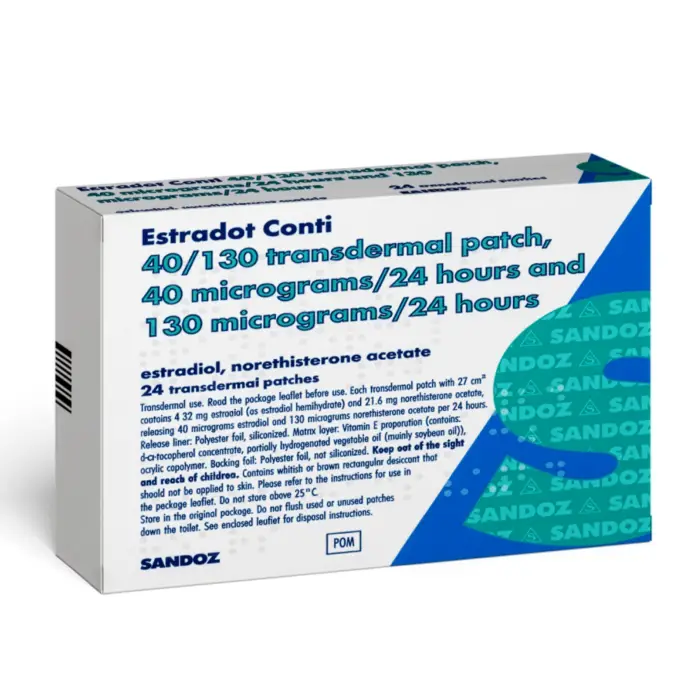
Images for illustrative purposes only
Looking for Next Day delivery?
Order before 15:30 on Monday to Friday for next day delivery
Estradot Conti
- Eases menopause symptoms such as hot flushes, as continuous combined HRT, if you still have your womb and your last period was at least 12 months ago
- For repeat supply only. We do not start HRT - order if you already use continuous combined HRT, or are switching from a similar combined patch
- One patch at a time, changed twice a week
What it is for
Estradot Conti eases the symptoms of the menopause. They come from the drop in oestrogen after your periods stop - such as a hot face, neck and chest (hot flushes).
It is a type of HRT (hormone replacement therapy) called continuous combined HRT. Each patch holds two hormones, and you use both every day without a break. You can use it if you still have your womb and have not had a natural period for at least 1 year. It is prescribed when your symptoms get in the way of daily life.
We supply Estradot Conti as a repeat, not as a first treatment. Order it if you already use continuous combined HRT and need more, or if you are switching from a similar combined patch. If you have never used HRT, or want to start a new type, your GP is the place to begin. We do not start HRT.
Next step: answer our health questions when you order. Tell us which HRT you use now, its strength, how long you have used it and how your symptoms are. A prescriber checks your answers before your patches are sent.
Had a hysterectomy? You do not need a progestogen, so this patch is not the right one. Estradot contains oestrogen only. For other menopause treatments, see our menopause service.
- You may get irregular bleeding or spotting in the first 3 to 6 months. See your doctor as soon as possible if it lasts beyond the first 6 months. The same goes if it starts after 6 months on the patch, or carries on after you stop.
Is it right for you?
Do not use Estradot Conti if you:
- have or have ever had breast cancer, or may have it
- have, or may have, a cancer that grows with oestrogen, such as cancer of the womb lining (endometrial cancer)
- have any vaginal bleeding that has not been explained
- have too much thickening of the womb lining (endometrial hyperplasia) that is not being treated
- have or have ever had a blood clot in a vein, such as in your leg (deep vein thrombosis) or lungs (pulmonary embolism)
- have a blood clotting disorder, such as protein C, protein S or antithrombin deficiency
- have or recently had a disease caused by blood clots in the arteries, such as a heart attack, stroke or angina (chest pain)
- have liver disease now, or had it and your liver tests have not gone back to normal
- have porphyria, a rare blood problem that runs in families
- are allergic to estradiol, norethisterone acetate, soya, peanuts or any other ingredient in the patch
Not sure about any of these? Ask our prescriber before you order. If any of them happens for the first time while you use the patch, stop using it and see your doctor straight away.
Tell us if you have or have ever had any of these. They can come back or get worse on HRT, so you need closer checks:
- fibroids inside your womb
- womb lining growing outside your womb (endometriosis), or too much growth of the womb lining in the past (endometrial hyperplasia)
- a higher chance of blood clots (see the Side effects tab)
- a higher chance of a cancer linked to oestrogen, such as a mother, sister or grandmother who has had breast cancer
- high blood pressure
- a liver problem, such as a liver tumour that is not cancer
- diabetes
- gallstones
- migraine or severe headaches
- lupus (SLE), a disease of the immune system that affects many organs
- epilepsy or asthma
- otosclerosis, a disease of the eardrum and hearing
- a very high level of fat in your blood (triglycerides)
- fluid build-up because of heart or kidney problems
- an underactive thyroid (hypothyroidism) that you take thyroid hormone for
- angioedema, or bouts of fast swelling of the hands, feet, face, lips, eyes, tongue, throat or gut
If you are over 65, there is only limited experience of this patch in women your age.
Which strength?
There are two strengths. They work the same way and only differ in how much hormone each patch releases.
- Estradot Conti 30/95 releases 30 micrograms of estradiol and 95 micrograms of norethisterone acetate every 24 hours. This is the starting strength.
- Estradot Conti 40/130 releases 40 micrograms of estradiol and 130 micrograms of norethisterone acetate every 24 hours.
Treatment starts on 30/95. If your symptoms are not under control after 3 months, the dose may go up to 40/130. Your prescriber aims for the lowest dose that treats your symptoms, for as short a time as you need it. Tell us if you think your dose is too strong or not strong enough.
Switching to Estradot Conti? From another continuous combined HRT, you can start on any day that suits you. From an HRT that gives you a monthly bleed (sequential or cyclical HRT), start the day after you finish that pack - but speak to your GP about this first, as it is a change of treatment.
How to use it
Change your patch twice a week, so a new patch every 3 or 4 days, with no break between patches. Pick two days and keep to them, for example Monday and Thursday.
Where to put it. Choose skin that does not crease much when you move, such as the side of your upper thigh. Use a different place each time. Never put it on or near your breasts.
- The skin should be hair-free, and not red or broken.
- Avoid places where clothes pinch, or under the edge of your clothes.
- Clean the skin well first. Do not use body lotion, body oil, shower gel, suntan products or anything else oily there. The skin must be dry.
Putting it on:
- Just before use, tear the pack open carefully at one of the two corners, along the perforation.
- Hold the patch by its edge and take it out. The drying pad stuck inside the pack keeps the patch in good condition. Never put it on your skin.
- Hold the clear protective liner with both hands. Gently bend the patch up and down along the curved perforated line.
- Peel off most of the liner. Do not touch the sticky layer.
- Stick the sticky part evenly onto your skin, with no air bubbles under it.
- Peel off the rest of the liner and stick down the rest of the patch.
- Press it with the flat of your hand for one minute.
Put on correctly, it should stick for at least 4 days. You can have a bath or a shower with it on, but it may come off in very hot bathwater or a sauna. Keep fatty creams, lotions and powders away from the patch. Sunlight and sunbeds can make it work less well.
If a patch comes off, or was not put on properly, do not reuse it. Put on a new patch, then change it on your usual day.
Forgot a patch? Put a new one on as soon as you can. If it is nearly time for your next change, just wait and keep to your usual days. Never wear two patches at once. A missed patch can make breakthrough bleeding more likely.
Used more patches than you should? Take them off and speak to a doctor or pharmacist straight away. Signs of too much can include tender breasts, bleeding, feeling or being sick, a painful or bloated tummy, anxiety, irritability and fluid build-up. You may also get wind, low mood, tiredness, spots or extra hair growth. These go once the patch is off.
Getting rid of used patches. A used patch still holds a lot of hormone, which can harm the environment. Fold it in half, sticky side inwards. Keep it out of the sight and reach of children. Do not flush it down the toilet. You can bring used or unused patches back to a pharmacy.
Keeping it under review
See your doctor for a check-up at least once a year, to talk through the benefits and risks of carrying on. Go for breast screening when you are invited.
Stop using Estradot Conti and see a doctor straight away if:
- your skin or the whites of your eyes turn yellow (jaundice), which can be a sign of liver disease
- your blood pressure rises a lot - signs may be headache, tiredness or dizziness
- you get migraine-like headaches for the first time
- you become pregnant
- your face, tongue or throat swells, or you find it hard to swallow, or you get hives with difficulty breathing (angioedema)
- you get signs of a blood clot: painful swelling and redness of the legs, sudden chest pain, or difficulty breathing
Having an operation? Tell the surgeon you use Estradot Conti. You may need to stop about 4 to 6 weeks before, to lower the risk of a blood clot. Ask your doctor when you can start again.
Other medicines
Tell our prescriber about every medicine you take, including ones you buy, herbal medicines and other natural products. Some medicines can get in the way of Estradot Conti, which might cause irregular bleeding:
- epilepsy medicines: phenobarbital, phenytoin, carbamazepine
- tuberculosis medicines: rifampicin, rifabutin
- HIV medicines: nevirapine, efavirenz, ritonavir, nelfinavir
- hepatitis C medicines, such as telaprevir
- ketoconazole and erythromycin, which treat infections
- herbal remedies with St John's wort in them
HRT can also change how some other medicines work. With lamotrigine for epilepsy, you could have seizures more often. Estradot Conti may affect how your body handles ciclosporin. Some hepatitis C combinations (such as glecaprevir with pibrentasvir) can raise a liver blood test in women using pills with ethinylestradiol. Estradot Conti has estradiol instead, and it is not known whether the same happens. Your doctor will advise you.
If you need a blood test, tell your doctor or the lab staff that you use Estradot Conti. It can affect the results of some tests.
Pregnancy and driving
Estradot Conti is only for women after the menopause. If you become pregnant, stop using it and contact your doctor. Do not use it while you are breastfeeding.
It is not a contraceptive. If your last period was less than 12 months ago, or you are under 50, you may still need contraception. Ask your doctor.
No effect on driving or using machines has been reported.
What it is and how it works
Each patch holds two hormones, which pass through your skin into your blood.
- Estradiol is an oestrogen. It is the same as the oestrogen your ovaries made before the menopause, and it replaces what your body has lost.
- Norethisterone acetate is a progestogen. Oestrogen on its own makes the lining of the womb grow, which raises the risk of a thickened lining and of womb cancer. The progestogen protects the lining from this.
Because the hormones go in through the skin, they do not pass through your liver first, as tablets do.
What it will not do
- It is not for you if you have had your womb removed. Use an oestrogen-only HRT such as Estradot.
- It is not a first treatment. We do not start HRT.
- HRT will not prevent memory loss.
Like all medicines, Estradot Conti can cause side effects, although not everybody gets them. Some of them happened less often with the lower strength, 30/95.
- Stop using Estradot Conti and get medical help straight away if you get:
- signs of a serious allergic reaction (anaphylaxis): hives, itching, swelling, difficulty breathing, pale and cold skin with a fast heartbeat, feeling dizzy, or sweating
- a swollen face, tongue or throat, trouble swallowing, or hives with difficulty breathing (angioedema)
- signs of a blood clot: painful swelling and redness of the legs, sudden chest pain, or difficulty breathing
Very common - may affect more than 1 in 10 people:
- headache
- skin reactions where the patch sits
- breast tension and pain
- painful periods (dysmenorrhoea), or changes to your bleeding
Common - may affect up to 1 in 10 people:
- feeling low (depression), nervous, emotions you cannot control, or mood changes
- dizziness, trouble sleeping
- feeling sick, a bloated tummy, diarrhoea, indigestion, wind or tummy pain
- spots (acne), rash, itching, dry or red skin
- back pain, pain in your hands or feet
- bigger breasts, heavy periods, vaginal discharge, irregular vaginal bleeding, cramps in the womb, or a vaginal infection
- abnormal growth of the womb lining (endometrial hyperplasia)
- pain, lack or loss of strength (asthenia), swollen hands, ankles or feet, weight gain
Uncommon - may affect up to 1 in 100 people:
- migraine, a spinning feeling (vertigo)
- a rise in blood pressure, varicose veins
- being sick
- changes in skin colour (discoloration)
- breast cancer
- raised liver enzymes in a blood test
Rare - may affect up to 1 in 1,000 people:
- an allergic reaction
- changes in sex drive
- tickling, itching or tingling feelings with no clear cause
- a blood clot in a vein
- gallbladder problems or gallstones
- muscle weakness (myasthenia)
- a non-cancerous growth in the womb, cysts around the fallopian tubes, or polyps in the neck of the womb (cervix)
Very rare - may affect up to 1 in 10,000 people:
- yellow skin or eyes caused by a blocked flow of bile (cholestatic jaundice)
Not known - how often cannot be told from the data:
- a severe allergic reaction (anaphylaxis)
- hair loss
The patch contains soya oil, which may very rarely cause allergic reactions. Any patch can cause an allergic skin reaction. Tell our prescriber if you have ever had a severe allergic reaction to any of the patch's ingredients.
Other HRTs have also been linked with gallbladder disease, dementia over the age of 65, dry eyes and changes in your tears. They have been linked with skin problems too:
- darker patches on the face or neck (chloasma)
- painful reddish lumps under the skin (erythema nodosum)
- a rash with target-shaped redness or sores (erythema multiforme)
- pinpoint bleeding spots in the skin (vascular purpura)
The risks of HRT
Every HRT carries some risks. Your prescriber weighs them against your symptoms, and the balance should be checked at least once a year.
- Breast cancer: HRT raises the risk, and the extra risk depends on how long you use it. It becomes clear within 3 years. Of women aged 50 to 54 not taking HRT, 13 to 17 in 1,000 will be diagnosed over 5 years. If you start combined HRT at 50 and take it for 5 years, it is 21 in 1,000 (an extra 4 to 8 cases). Over 10 years, it is 27 in 1,000 without HRT and 48 in 1,000 with combined HRT (an extra 21 cases). The extra risk falls after you stop, but it can last 10 years or more if you used HRT for more than 5 years.
- Womb cancer: oestrogen-only HRT raises the risk of too much thickening of the womb lining and of womb cancer. The progestogen in Estradot Conti protects you from this extra risk.
- Ovarian cancer is rare - much rarer than breast cancer. Of women aged 50 to 54 not taking HRT, about 2 in 2,000 will be diagnosed over 5 years. After 5 years of HRT, it is about 3 in 2,000 (about 1 extra case).
- Blood clots in a vein are about 1.3 to 3 times more likely with HRT, most of all in the first year. A clot that travels to the lungs can cause chest pain, breathlessness, fainting or even death. Of women in their 50s not taking HRT, 4 to 7 in 1,000 would get one over 5 years. After over 5 years of combined HRT, it is 9 to 12 in 1,000 (an extra 5 cases).
- Stroke is about 1.5 times more likely with HRT. Of women in their 50s not taking HRT, 8 in 1,000 would have a stroke over 5 years. With HRT, it is 11 in 1,000 (an extra 3 cases). The extra cases rise with age.
- Heart disease: there is no evidence that HRT prevents a heart attack. If you are over 60, combined HRT makes heart disease slightly more likely.
- Memory: HRT will not prevent memory loss. There is some evidence of a higher risk of memory loss if you start HRT after 65.
Blood clots are more likely as you get older, and if you:
- cannot walk for a long time because of major surgery, an injury or an illness
- are seriously overweight (BMI over 30)
- have a blood clotting problem that needs long-term treatment with a medicine to prevent clots
- have a close relative who has had a blood clot in the leg, lung or another organ
- have lupus (SLE) or cancer
Tell our prescriber if any of these apply.
Check your breasts regularly. See your doctor if you notice any changes, such as dimpled skin, changes in a nipple, or any lump you can see or feel. When you have a mammogram, tell the person taking the x-ray that you use HRT. HRT can make your breasts denser, so a mammogram may not pick up every lump.
You can report any side effect to the MHRA through the Yellow Card scheme, or search for MHRA Yellow Card in the Google Play or Apple App Store.
Can I get Estradot Conti if I have never used HRT?
No. We supply it as a repeat to women who already use continuous combined HRT, or who are switching from a similar combined patch. To start HRT for the first time, speak to your GP.
I have had a hysterectomy. Is this the right patch?
Probably not. The progestogen in Estradot Conti is there to protect the womb lining. Without a womb you do not need it, so an oestrogen-only patch such as Estradot is the usual choice. Your prescriber will check.
I use Evorel Conti now. Can I switch?
Often, yes - our prescriber decides. In a study, Estradot Conti 30/95 gave similar levels of both hormones over 4 days to Evorel Conti 50/170. If you are changing from another continuous combined HRT, you can start on any day. Tell us your current patch and strength when you order. If you want to stay on Evorel Conti, you can order Evorel Conti instead.
Which strength will I get?
That depends on what you use now. If you are switching, you will usually start on 30/95. Your prescriber may move you to 40/130 if your symptoms are not under control after 3 months.
Will I have any bleeding?
You may get irregular bleeding or spotting in the first 3 to 6 months. In studies, most women were new to HRT. With the 30/95 patch, 63.4% had some bleeding or spotting in the first 3 months, and 33.9% had none at all in months 10 to 12. With the 40/130 patch, the figures were 53.3% and 47.1%. See your doctor as soon as possible if bleeding carries on past 6 months, starts after 6 months, or goes on after you stop.
I am allergic to peanuts or soya. Can I use it?
No. The patch contains soya oil, so do not use it if you are allergic to soya or peanuts. Tell our prescriber about any allergies when you order.
Where do I put the patch?
On clean, dry, hair-free skin that does not crease much when you move, such as the side of your upper thigh. Keep it away from oily products and the edges of your clothes, and use a new spot each time. Never put it on or near your breasts.
Can I shower or bathe with the patch on?
Yes. Put on correctly, it should stick for at least 4 days. It may come off in very hot bathwater or a sauna.
What if the patch falls off?
Do not stick it back on. Put on a new patch, then change it on your usual day.
How long can I keep using it?
For as long as the benefits outweigh the risks for you. HRT should be the lowest dose that works, for the shortest time you need it. Your treatment should be reviewed at least once a year.
Does it raise my risk of breast cancer?
Yes, a little, and the risk grows the longer you use combined HRT. The Side effects tab gives the figures. Keep checking your breasts and go to screening when invited.
Ingredients
- Active ingredients: estradiol (as hemihydrate) and norethisterone acetate
- Estradot Conti 30/95: each 20 cm2 patch contains 3.2 mg estradiol and 16 mg norethisterone acetate, releasing 30 micrograms of estradiol and 95 micrograms of norethisterone acetate every 24 hours
- Estradot Conti 40/130: each 27 cm2 patch contains 4.32 mg estradiol and 21.6 mg norethisterone acetate, releasing 40 micrograms of estradiol and 130 micrograms of norethisterone acetate every 24 hours
- Other ingredients: a vitamin E preparation (d-alpha-tocopherol concentrate and partially hydrogenated vegetable oil, mainly soybean oil) and an acrylic copolymer in the sticky layer; a polyester backing; a siliconised polyester liner that you peel off
It contains soya oil. Do not use it if you are allergic to soya or peanuts.
What it looks like
A clear patch with rounded corners, on a larger protective liner. Each patch is sealed in its own protective pack.
Storage
- Do not store above 25°C.
- Keep the patches in the original pack.
- Keep them out of the sight and reach of children.
- Do not use them after the expiry date on the sachet and carton.
- Do not flush used patches down the toilet. Fold them in half, sticky sides together, or bring them back to a pharmacy.
Licence and maker
A prescription-only medicine (POM). Licence numbers PL 04416/1743 (30/95) and PL 04416/1744 (40/130). The licence holder is Sandoz Limited, Camberley, Surrey. It is made by Hexal AG, Holzkirchen, Germany.
Leaflet
Read the leaflet in the pack before you put on your first patch from a new box.
Related
- Menopause - online doctor - our menopause service
- Evorel Conti - another continuous combined HRT patch
- Estradot - the oestrogen-only patch, if you have had a hysterectomy
Sources
The facts on this page come from these documents:
- Estradot Conti 30/95 transdermal patch - Summary of Product Characteristics (emc) - Sandoz. Revised 24 March 2025
- Estradot Conti 40/130 transdermal patch - Summary of Product Characteristics (emc) - Sandoz. Revised 24 March 2025
- Estradot Conti 30/95 transdermal patch - patient information leaflet (MHRA Products) - Sandoz, PL 04416/1743, last revised February 2025
- Estradot Conti 40/130 transdermal patch - patient information leaflet (MHRA Products) - Sandoz, PL 04416/1744, last revised February 2025
- Estradot Conti - Public Assessment Report (MHRA) - licences PL 04416/1743-1744 and their legal status
- MHRA Yellow Card scheme - how to report a side effect
The leaflet inside your pack is the one that applies to your patches. Last checked against these sources: 30 October 2026.

