
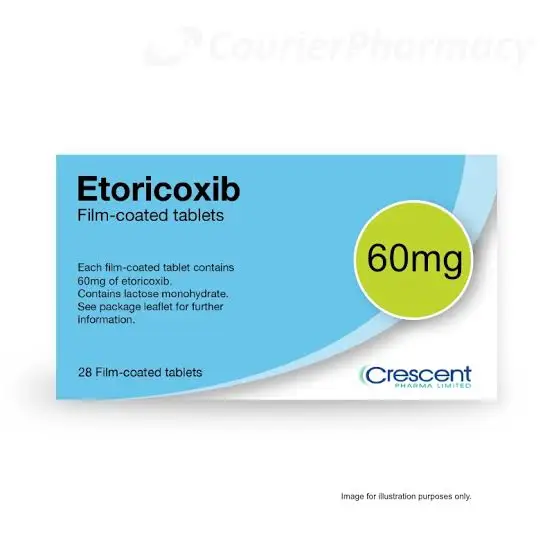
Images for illustrative purposes only
Looking for Next Day delivery?
Order before 15:30 on Monday to Friday for next day delivery
Etoricoxib Tablets
- Eases pain and swelling from osteoarthritis, rheumatoid arthritis, ankylosing spondylitis and gout attacks, and pain after dental surgery
- For ages 16 and over
- Not for you if you have angina or heart failure, or have had a heart attack or stroke. Your blood pressure must be under control, too
- One tablet a day, with or without food - your condition decides the strength
- Prescription-only: answer our health questions, and a prescriber checks them before your tablets are sent
What it is for
Painful, stiff or swollen joints? Etoricoxib tablets ease the pain and swelling of:
- osteoarthritis - wear of the cartilage that cushions the ends of your bones
- rheumatoid arthritis - a long-term condition that inflames your joints
- ankylosing spondylitis - inflammation of your spine and large joints
- gout - sudden attacks of very painful, red, swollen joints, caused by crystals in the joint
It is also used for a short time, up to 3 days, for moderate pain after dental surgery.
You must be 16 or over to take it.
Next step: answer our health questions when you order. A prescriber checks them before anything is sent.
Etoricoxib may slightly increase your risk of heart attack and stroke. The risk may rise with higher doses and longer use. So take the lowest dose that controls your pain, for the shortest time you need it. Do not take it at all if you have angina, moderate or severe heart failure, or poor circulation in your legs. The same goes if you have ever had a heart attack, a stroke or a mini-stroke.
Is it right for you?
Do not take it if you:
- are under 16
- are allergic to etoricoxib or any other ingredient in it
- have had wheezing, a runny or blocked nose, nasal polyps, hives, swelling or another allergic reaction after taking aspirin or another anti-inflammatory painkiller (NSAID)
- have a stomach ulcer now, or bleeding in your stomach or gut
- have serious liver disease or serious kidney disease
- have an inflammatory bowel disease, such as Crohn's disease or ulcerative colitis
- have high blood pressure that is not under control - readings that stay above 140/90 even with treatment
- have moderate or severe heart failure
- have angina (chest pain), or have had a heart attack or heart bypass surgery
- have poor circulation in your legs or feet because of narrow or blocked arteries (peripheral arterial disease)
- have had any kind of stroke, including a mini-stroke (TIA)
- are pregnant, could be pregnant, or are breastfeeding
Talk to our prescriber or your doctor before you take it if you:
- have had a stomach ulcer or bleeding in the past
- are dehydrated - for example, after a long bout of being sick or diarrhoea
- have swelling from fluid build-up
- have ever had heart failure or another heart problem
- have high blood pressure now, or had it in the past
- have liver or kidney disease, now or in the past
- are being treated for an infection
- have diabetes or high cholesterol, or you smoke - each of these raises your risk of heart disease
- are trying to get pregnant
- are over 65
Have you been told you cannot digest some sugars? Ask our pharmacist before you order. Some makers put lactose in their tablets, and your pack could be one of those.
Your blood pressure
This medicine can push your blood pressure up. It can raise it more often, and more severely, than some other anti-inflammatory painkillers. That is most likely at high doses.
So your blood pressure must be under control before you start. Have it checked within 2 weeks of starting, then from time to time after that. If it goes up a lot, your prescriber may need to switch you to a different treatment.
Your heart, stomach, kidneys and liver
Heart. It can cause fluid build-up and swelling. It can also bring on heart failure, or make it come back. Short of breath, or ankles swelling? Stop taking it and talk to a doctor straight away.
Stomach and gut. Ulcers, holes in the gut wall (perforation) and bleeding can happen. Some have been fatal. The risk is higher if you are older, take aspirin or another anti-inflammatory, or have had an ulcer or bleeding before.
Kidneys. It can reduce blood flow to your kidneys. This matters most if your kidneys already work poorly, or you have heart failure or liver scarring (cirrhosis). If you are dehydrated, tell our prescriber - it is best to put the fluid back before you start.
Liver. It can affect your liver. Your prescriber may stop it if blood tests show liver changes. With mild liver disease, the most you can take is 60 mg a day. With moderate liver disease, it is 30 mg a day.
It can also hide a fever, which is a sign of infection.
How to take it
Take one tablet once a day. You can take it with or without food, though it may start to work faster on an empty stomach.
Your condition sets the dose:
| Condition | Usual dose | Highest dose |
|---|---|---|
| Osteoarthritis | 30 mg once a day | 60 mg once a day |
| Rheumatoid arthritis | 60 mg once a day | 90 mg once a day |
| Ankylosing spondylitis | 60 mg once a day | 90 mg once a day |
| Gout attack | 120 mg once a day | 120 mg once a day, for 8 days at most |
| Pain after dental surgery | 90 mg once a day | 90 mg once a day, for 3 days at most |
For a gout attack or dental pain, take it only while the pain is at its worst. Never take more than the dose for your condition. Higher doses have not been shown to work better.
Your prescriber will want to review how it is going from time to time. Use the lowest dose that controls your pain, for no longer than you need it.
Missed a dose? Just carry on as usual the next day. Never take two at once to make up.
Taken too many? Get medical help straight away.
Pregnancy, breastfeeding and fertility
Do not take it if you are pregnant, think you could be, or are planning a pregnancy. If you become pregnant while you take it, stop and talk to your doctor.
You must not breastfeed while you take it.
It is not recommended if you are trying to get pregnant.
Driving
It can make you dizzy or sleepy, or give you a spinning feeling (vertigo). If it does, do not drive or use tools or machines.
Other medicines
Tell our prescriber about every medicine you take, including ones you buy without a prescription. Your doctor may want to keep an eye on you if you take:
- blood thinners (anticoagulants), such as warfarin
- for blood pressure or heart failure: ACE inhibitors such as enalapril and ramipril, angiotensin receptor blockers such as losartan and valsartan, water tablets (diuretics), digoxin, or minoxidil
- to calm the immune system: methotrexate, ciclosporin or tacrolimus
- lithium, for some types of depression
- rifampicin, an antibiotic
- salbutamol tablets or oral solution, for asthma
- the contraceptive pill or HRT - taking either with it may raise your risk of side effects
Aspirin. You can take it with low-dose aspirin for your heart. Do not stop the aspirin unless your doctor says so. This medicine does not protect your heart the way aspirin does. But the risk of a stomach ulcer is higher when you take the two together.
Do not take high-dose aspirin, or any other anti-inflammatory painkiller, while you take it.
What it is and how it works
Etoricoxib belongs to a group of medicines called selective COX-2 inhibitors. These are part of a bigger family called non-steroidal anti-inflammatory drugs (NSAIDs).
Your body uses an enzyme called COX-2 to make chemicals that cause pain and swelling. Etoricoxib blocks it.
What it will not do
- It does not cure arthritis or gout. It eases the pain and swelling.
- It is not for anyone under 16.
- It does not protect your heart the way low-dose aspirin does.
Looking for something else? Browse our pain range, or ask our pharmacy team which option suits you.
The one very common side effect is stomach pain. Most of the others are common or less often.
Stop taking etoricoxib and talk to a doctor straight away if you get signs of a heart, liver, stomach, allergy or skin problem.
Look out for:
shortness of breath, chest pain or ankle swelling - or any of these getting worse
yellow skin or yellow whites of the eyes (jaundice), a sign of liver problems
bad or constant stomach pain, or black stools
an allergic reaction - such as skin ulcers or blisters, or a swollen face, lips, tongue or throat that may make it hard to breathe
any skin rash, or sores in your mouth - most skin reactions start in the first month
Very common - may affect more than 1 in 10 people:
- stomach pain
Common - may affect up to 1 in 10 people:
- dry socket (inflammation and pain after a tooth is taken out)
- swollen legs or feet from fluid build-up
- dizziness, headache
- a fast or irregular heartbeat (palpitations, arrhythmia)
- higher blood pressure
- wheezing or shortness of breath (bronchospasm)
- constipation, wind, heartburn, diarrhoea, indigestion or stomach discomfort, feeling or being sick, inflamed stomach lining (gastritis), inflamed food pipe, mouth ulcers
- changes in blood tests of your liver
- bruising
- weakness and tiredness, flu-like illness
Uncommon - may affect up to 1 in 100 people:
- stomach bug (gastroenteritis), chest or throat infection, urine infection
- fewer red cells, white cells or platelets in your blood
- allergic reaction, including hives, which may need urgent help
- feeling more or less hungry, weight gain
- anxiety, depression, finding it harder to think clearly, seeing, feeling or hearing things that are not there (hallucinations)
- changes in taste, trouble sleeping, numbness or tingling, sleepiness
- blurred vision, sore red eyes
- ringing in the ears, a spinning feeling (vertigo)
- heart rhythm changes (atrial fibrillation), a fast heart rate, changes in your heart tracing (ECG), heart failure, chest tightness (angina), heart attack
- flushing, stroke, mini-stroke (TIA), a sudden severe rise in blood pressure, inflamed blood vessels
- cough, breathlessness, nosebleed
- a bloated stomach, changes in your bowel habits, dry mouth, irritable bowel syndrome
- a stomach ulcer, or ulcers that bleed or make a hole in the gut, and an inflamed pancreas
- a swollen face, rash or itchy skin, red skin
- muscle cramps or spasms, muscle pain or stiffness
- high potassium in your blood, changes in kidney blood or urine tests, serious kidney problems
- chest pain
Rare - may affect up to 1 in 1,000 people:
- a serious allergic reaction - a swollen face, lips, tongue or throat that makes it hard to breathe or swallow (angioedema)
- sudden collapse from a severe allergic reaction (anaphylactic shock)
- confusion, restlessness
- liver inflammation (hepatitis), liver failure, yellow skin or eyes (jaundice)
- low sodium in your blood
- severe skin reactions, including Stevens-Johnson syndrome and toxic epidermal necrolysis
- a rash that comes back in the same place each time you take it (fixed drug eruption)
Kidney damage has also been reported with anti-inflammatory painkillers, and cannot be ruled out with etoricoxib. This includes inflamed kidneys (interstitial nephritis) and nephrotic syndrome, where the kidneys leak protein.
You can report any side effect to the MHRA through the Yellow Card scheme. Or search for MHRA Yellow Card in the Google Play or Apple App Store.
What conditions is etoricoxib used for?
The pain and swelling of osteoarthritis, rheumatoid arthritis, ankylosing spondylitis and gout attacks. It is also used for up to 3 days for moderate pain after dental surgery. All of these are for ages 16 and over.
Which strength will I get?
That depends on your condition. Osteoarthritis starts at 30 mg, rheumatoid arthritis and ankylosing spondylitis at 60 mg, and pain after dental surgery is 90 mg. The 120 mg dose is only for a gout attack. The dose table in the overview has the full detail.
Why can I only take the gout dose for 8 days?
The 120 mg dose is only for the painful days of a gout attack, for 8 days at most. Heart risks may rise with higher doses and longer use, so take it for the shortest time you need.
Can I take it if I have high blood pressure?
Only if it is under control. If your readings stay above 140/90 even with treatment, you must not take it. Get your blood pressure checked within 2 weeks of starting, and from time to time after that.
Can I take it with low-dose aspirin?
Yes. Keep taking your low-dose aspirin, because etoricoxib does not protect your heart. The two together raise the risk of a stomach ulcer, though, so tell our prescriber you take it.
Can I take it with ibuprofen or naproxen?
No. Do not take any other anti-inflammatory painkiller (NSAID), or high-dose aspirin, while you take etoricoxib. For anything else, check with our pharmacist first.
Does it contain lactose?
It depends on the maker. Etoricoxib from Organon (Arcoxia), Viatris, Brown & Burk and Strides contains lactose. Etoricoxib from Zentiva, Milpharm, Glenmark and Krka does not. If you cannot have lactose, ask our pharmacist before you order. Check the ingredients in the leaflet in your pack.
Is it the same as Arcoxia?
Arcoxia is Organon's brand of etoricoxib. Each tablet has the same active ingredient in the same strengths, and the same licensed uses. The inactive ingredients differ from maker to maker, including whether there is lactose.
What if I miss a dose?
Carry on with your usual tablet the next day. Do not take two to make up.
Can I take it if I am pregnant or breastfeeding?
No. Do not take it if you are pregnant, could be pregnant or are planning a pregnancy, and do not breastfeed while you take it. It is not recommended if you are trying to get pregnant.
Can I drive while taking it?
Yes, unless it makes you dizzy, sleepy or gives you a spinning feeling. If it does, do not drive or use machines.
Why is it not for under-16s?
It is not licensed for anyone under 16, so it must not be given to children or teenagers younger than that.
Ingredients
Active ingredient: etoricoxib - 30 mg, 60 mg, 90 mg or 120 mg in each tablet.
Other ingredients depend on the maker. Every maker uses microcrystalline cellulose, calcium hydrogen phosphate and croscarmellose sodium in the tablet core. The rest:
- Organon (Arcoxia): magnesium stearate; coating of carnauba wax, lactose monohydrate, hypromellose, titanium dioxide (E171) and triacetin. The 30, 60 and 120 mg tablets also contain indigo carmine lake (E132) and yellow ferric oxide (E172).
- Viatris: colloidal anhydrous silica, magnesium stearate; coating of hypromellose, lactose monohydrate, titanium dioxide (E171), triacetin and carnauba wax. Its 30 mg tablets also contain brilliant blue FCF (E133) and black and yellow iron oxide (E172). The 60 mg and 120 mg have indigo carmine (E132) and yellow iron oxide (E172) instead. There is no colouring in the 90 mg.
- Brown & Burk: lactose monohydrate, hydroxypropyl cellulose, magnesium stearate; coating of hypromellose, lactose monohydrate, titanium dioxide (E171) and triacetin. The 30, 60 and 120 mg tablets also contain indigo carmine aluminium lake (E132) and yellow iron oxide (E172).
- Strides: magnesium stearate; coating of hypromellose, lactose monohydrate, titanium dioxide, triacetin and carnauba wax. The 30, 60 and 120 mg tablets also contain yellow iron oxide and indigo carmine aluminium lake.
- Zentiva: colloidal anhydrous silica, talc, magnesium stearate; coating of hypromellose, hydroxypropylcellulose, macrogol 6000, talc and titanium dioxide (E171). Colourings: 60 mg brown ferric oxide, 90 mg yellow ferric oxide, 120 mg red ferric oxide (all E172).
- Milpharm: magnesium stearate (E470b); coating of polyvinyl alcohol (E1203), titanium dioxide (E171), glycerol monostearate (E471), talc (E553b) and sodium laurilsulfate. The 30, 60 and 120 mg tablets also contain indigo carmine aluminium lake (E132) and yellow iron oxide (E172).
- Glenmark: magnesium stearate; coating of hypromellose, titanium dioxide (E171) and macrogol. The 30, 60 and 120 mg tablets also contain indigo carmine aluminium lake (E132) and yellow iron oxide (E172). Isopropyl alcohol and methylene chloride are also listed for the coating.
- Krka: sodium stearyl fumarate, colloidal anhydrous silica; coating of polyvinyl alcohol, titanium dioxide (E171), macrogol 3000 and talc. Colourings: 60 mg yellow ferric oxide, 90 mg and 120 mg red ferric oxide (E172).
Your pack may come from any of these makers. The leaflet inside your pack is the one that applies to your tablets.
Lactose per tablet (as lactose monohydrate)
| Maker | 30 mg | 60 mg | 90 mg | 120 mg |
|---|---|---|---|---|
| Organon (Arcoxia) | 1.3 mg | 2.7 mg | 4.0 mg | 5.3 mg |
| Viatris | 0.80 mg | 1.60 mg | 2.39 mg | 3.19 mg |
| Brown & Burk | 1.40 mg | 2.80 mg | 4.20 mg | 5.60 mg |
| Strides | 0.84 mg | 1.68 mg | 2.52 mg | 3.36 mg |
| Zentiva, Milpharm, Glenmark, Krka | none | none | none | none |
Storage
- Keep it out of the sight and reach of children.
- How to store it depends on the maker. Follow the instructions on your pack.
- Do not use it after the expiry date on the pack.
- Do not throw medicines away in wastewater or household rubbish. Ask your pharmacist how to get rid of any you no longer need.
Leaflet
Read the leaflet in the pack before you take your first tablet. Each maker's leaflet is linked below.
Related
Sources
The facts on this page come from these documents, one pair for each maker your pack may come from:
- Arcoxia (Organon Pharma (UK) Limited): Summary of Product Characteristics (emc) - revised 19 March 2025; patient information leaflet (emc) - revised September 2024
- Etoricoxib Mylan (Viatris): SmPC (emc) - revised September 2020; leaflet (emc) - revised May 2024
- Etoricoxib (Brown & Burk UK Ltd): SmPC (emc) - revised 8 December 2021; leaflet (emc) - revised August 2017
- Etoricoxib (Strides Pharma UK Ltd): SmPC (emc) - revised 15 December 2023; leaflet (emc) - revised December 2023
- Etoricoxib (Zentiva): SmPC (emc) - revised 31 December 2020; leaflet (emc) - revised June 2023
- Etoricoxib (Aurobindo Pharma - Milpharm Ltd): SmPC (emc) - revised 22 April 2026; leaflet (emc) - revised October 2025
- Etoricoxib (Glenmark Pharmaceuticals Europe Ltd): SmPC (emc) - revised 31 December 2020; leaflet (emc) - revised November 2023
- Etoricoxib (Krka UK Ltd): SmPC (emc) - revised 26 May 2019; leaflet (emc) - revised January 2024
- MHRA Yellow Card scheme - how to report a side effect
Each link is the 60 mg page. Each maker's leaflet covers all four strengths. The leaflet inside your pack is the one that applies to your tablets. Last checked against these sources: 13 October 2026.

