
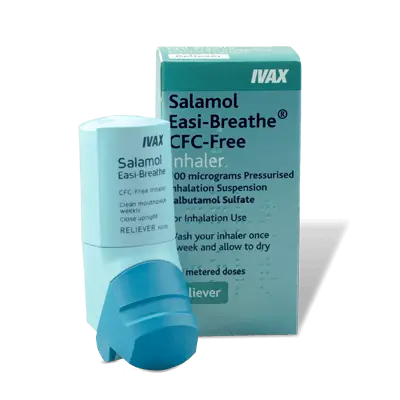
Images for illustrative purposes only
Looking for Next Day delivery?
Order before 15:30 on Monday to Friday for next day delivery
Salamol Easi-Breathe
- Relieves asthma symptoms - wheezing, breathlessness and a tight chest - and can stop exercise or allergens setting off your asthma
- For people already using Salamol Easi-Breathe for asthma - repeat supply only
- It is a reliever, so you should also have a preventer inhaler (an inhaled steroid)
- Breath-operated: the puff comes out by itself when you breathe in, so there is nothing to press. Want a press-and-breathe inhaler? See Ventolin or Salbutamol inhalers
- Needing it more than twice a week, not counting before exercise, means your asthma is not well controlled. Contact your doctor
What it is for
Salamol Easi-Breathe is a reliever inhaler for asthma. Use it when you need it, to ease wheezing, breathlessness and a tight chest.
You can also use it before exercise, or before you meet something you know sets off your asthma, such as house dust or pollen. That helps stop an attack starting.
It is licensed for adults and children aged 4 and over.
Next step: for people already using Salamol Easi-Breathe for asthma - repeat supply only. Start our health questions when you order. Your inhaler is only sent once a prescriber has checked your answers.
- If you use Salamol Easi-Breathe more than twice a week to treat your asthma symptoms, not including preventive use before exercise, this indicates poorly controlled asthma and may increase the risk of severe asthma attacks (worsening of asthma) that can have serious complications and may be life-threatening or even fatal. You should contact your doctor as soon as possible to review your asthma treatment.
A reliever, not a preventer
Salamol Easi-Breathe contains salbutamol. It is a fast-acting bronchodilator - a medicine that widens your airways so air can move in and out more easily. It starts to work within 5 minutes, and the effect lasts about 4 to 6 hours.
It eases symptoms, but it is not an anti-inflammatory. So in asthma it should not be your main or only treatment. It should be prescribed with an inhaled corticosteroid - a daily preventer medicine that works against inflammation in your lungs.
Keep using your preventer regularly, even when you feel better and do not need your reliever.
How the Easi-Breathe works
This is a breath-operated inhaler. You do not press the can to take a dose. When you breathe in through the mouthpiece, the inhaler releases the puff into your mouth by itself.
Two things matter. Hold it upright, because it only works in that position. And keep your hand clear of the air holes.
There is no dose counter. Each inhaler holds 200 puffs, so it helps to keep a note of how many you have used.
Is it right for you?
Do not use it if you:
- are allergic to salbutamol or to the other ingredients (ethanol and norflurane)
- go into labour early (premature labour), or have a threatened miscarriage
Talk to our prescriber before you use it if you:
- have had an allergic reaction to other sympathomimetic medicines (medicines that act like adrenaline)
- have an overactive thyroid (hyperthyroidism or thyrotoxicosis)
- have a severe heart problem. This includes a recent heart attack, coronary heart disease, a thickened heart muscle (hypertrophic obstructive cardiomyopathy), or a fast heartbeat or heart rhythm
- have high blood pressure that is severe and not treated, or an aneurysm (a bulge in a blood vessel wall)
- take heart medicines called cardiac glycosides (digitalis)
- have diabetes that is hard to control - salbutamol can raise your blood sugar
- have phaeochromocytoma, a disease of the inner part of the adrenal gland
If you are pregnant or breast-feeding, ask your doctor or pharmacist first. It should not be used in pregnancy, especially in the first three months or near the end, unless your doctor decides it is clearly needed. In breast-feeding, your doctor weighs up the benefit and the risk first.
How much to use
Adults:
- To relieve symptoms: one puff to start. Take a second puff if you need it.
- Before exercise or a known trigger: two puffs, 10 to 15 minutes before.
Limits: do not take more than eight puffs in 24 hours. Wait 4 hours between doses. Use it when you need it rather than on a fixed schedule, unless your prescriber has told you otherwise.
Being older does not change the dose. Nor do kidney or liver problems.
Never take more, or use it more often, than your prescriber has told you. Tell your doctor as soon as possible if it does not seem to work as well as usual. For example, you may need more puffs to ease your breathing, or it may not give relief for at least 3 hours. That can mean your asthma is getting worse and you need a different medicine.
- If your breathing gets worse suddenly or quickly, get medical help at once.
How to use it
Sit or stand up straight.
- Shake the inhaler hard.
- Hold it upright. Open it by folding down the cap that covers the mouthpiece.
- Breathe out gently, as far as is comfortable. Close your lips firmly around the mouthpiece. Keep the inhaler upright, with your hand away from the air holes. Now breathe in slowly and deeply through the mouthpiece - and do not stop when you feel the puff. Keep going until you have taken a deep breath.
- Take the inhaler out of your mouth. Hold your breath for 10 seconds, or as long as is comfortable, then breathe out slowly.
- Hold it upright and close the cap straight away.
- Need another puff? Close the cap, wait about one minute, then start again from step 1.
Before you use it for the first time
Test it by firing two puffs into the air. Do the same if you have not used it for five days or more.
To do this, unscrew the top so you can see the metal can. Open the cap and shake the inhaler. Then press the can with your finger or thumb to spray. Close the cap and screw the top back on.
Keeping count of your puffs
Your inhaler has no dose counter. It holds 200 puffs, and that includes the test puffs you spray into the air.
After 200 puffs it can keep spraying gas, but with no proper dose of salbutamol in it. Shaking it, weighing it or floating it in water will not tell you reliably whether it is empty.
So keep a record of the puffs you use. A spare inhaler is worth thinking about too. If you have more than one, count each one on its own.
Cleaning it once a week
Clean your inhaler once a week, especially the mouthpiece. This stops the spray building up inside and blocking it.
- Unscrew and remove the top. Keep the top dry at all times.
- Take the metal can out of the bottom part. Never put the can in water.
- Rinse the bottom part under warm running water for at least 30 seconds.
- Shake off the water and dry it well - overnight if you can. Do not use direct heat. Put the can back, close the cap and screw the two parts together.
If the mouthpiece is not fully dry, it is more likely to block.
Need it before it has dried? Shake off the water, put the can back and test-fire two puffs into the air. Then take your usual dose. Wash and dry it again afterwards.
If it stops working
Unscrew the top and press the can down. If it still does not seem to work, it may be blocked, so clean it as above. Still not working? Take it back to your doctor or pharmacist.
Other medicines
Tell our prescriber about every medicine you take, including ones you buy yourself.
- Beta-blockers, used to lower blood pressure. Salbutamol and non-selective beta-blockers such as propranolol should not usually be prescribed together. Each weakens the other, and in asthma a beta-blocker can bring on a severe narrowing of the airways.
- Water tablets (diuretics), steroid medicines, theophylline and digitalis. Taken with high doses of salbutamol, these can lower the potassium in your blood further.
- Theophylline and other sympathomimetic medicines. Each can strengthen the other's effects, with a higher chance of side effects.
- Heart rhythm medicines such as digitalis or quinidine - a higher chance of side effects.
- Diabetes medicines - salbutamol can weaken their effect on blood sugar. This is mostly at the higher doses used in tablets or injections.
- MAOIs or tricyclic antidepressants - these can increase salbutamol's effect on your heart and blood vessels.
- Procarbazine, a cancer medicine - your blood pressure can rise.
- Ergotamine and similar medicines - use with care, as the effect on your blood vessels is hard to predict.
- L-dopa, levothyroxine (L-thyroxine), oxytocin and alcohol can affect your heart and blood vessels together with salbutamol.
- Disulfiram or metronidazole - the inhaler contains a small amount of alcohol, so in theory they could interact.
Having an operation
If you need a general anaesthetic, tell the anaesthetist you use Salamol Easi-Breathe. Do not use it for at least 6 hours before the anaesthetic.
Driving
No studies have looked at whether it affects driving or using machines.
Cold weather
A cold inhaler may not work as well. If the medicine gets very cold, take the metal can out and warm it in your hands for a few minutes before you use it. Do not warm it any other way.
What it will not do
- It is not a preventer. If you have asthma, it should be prescribed with a daily inhaled steroid.
- We do not start you on Salamol Easi-Breathe. If you have not used it before, talk to your GP or asthma nurse.
- It is not a regular, every-day treatment for adults - you use it when you need it.
Want to see other options? Visit our asthma range.
Like all medicines, it can cause side effects, although not everybody gets them. Feeling shaky, headaches and a faster heartbeat are among the most common.
- Stop using Salamol Easi-Breathe and contact your doctor straight away if you get an allergic reaction. Do the same if your breathing gets worse straight after a puff.
- Look out for:
- an allergic reaction - wheezing, coughing or trouble breathing, a rash, swelling of your face or throat, or a fall in blood pressure. You may collapse (very rare, may affect up to 1 in 10,000 people)
- wheezing that gets worse straight after a puff (paradoxical bronchospasm). Use a different fast-acting reliever straight away and tell your doctor (very rare)
- chest pain or other signs of worsening heart disease, if you have a severe heart problem. Get urgent medical help (poor blood flow to the heart muscle is uncommon, may affect up to 1 in 100 people)
Common - may affect up to 1 in 10 people:
- high blood sugar
- feeling tense, and headaches (more likely at higher doses)
- feeling shaky (muscle tremors)
- dizziness
- a fast heartbeat
Uncommon - may affect up to 1 in 100 people:
- restlessness
- a forceful heartbeat that may be fast or uneven
- poor blood flow to the heart muscle (myocardial ischaemia)
- a sore or irritated mouth or throat, a change in how things taste
- muscle pain (myalgia), muscle cramps
Rare - may affect up to 1 in 1,000 people:
- low potassium in your blood. You may notice an uneven heartbeat, weak muscles or cramp
- a build-up of lactic acid in your blood. Signs include feeling sick and being sick that do not stop, and tiredness you cannot explain. You may also be short of breath, breathe fast, or have cold or blue hands and feet
- trouble sleeping, and seeing or hearing things that are not real (more likely in children)
- more blood flow to your hands and feet (peripheral dilatation)
- feeling sick, being sick, a dry or sore mouth
Very rare - may affect up to 1 in 10,000 people:
- allergic reactions, including itching, hives (urticaria), swelling of the mouth and throat (angioedema), skin rash, tight airways, a drop in blood pressure and collapse
- difficulty sleeping (insomnia)
- heart rhythm problems, including atrial fibrillation, a fast heartbeat (supraventricular tachycardia) and extra beats (ventricular extrasystoles), and chest tightness (angina-type pain)
- wheezing that gets worse straight after a puff (paradoxical bronchospasm)
- itchy skin
- trembling, particularly of the hands
Rarely, you may also get problems passing urine, heartburn, or a rise or fall in blood pressure.
In children, trouble sleeping, seeing or hearing things that are not real, and being overactive (hyperactivity) have also been reported.
Mild shaking, restlessness, headache and muscle spasms may settle within 1 to 2 weeks as you keep using it.
Used too many puffs? Your heart may beat faster than usual. You may feel shaky or tense, get a headache, and your skin may look flushed and feel hot. These effects usually wear off within a few hours, but tell your doctor as soon as possible. They may want to check the potassium in your blood.
You can report any side effect to the MHRA through the Yellow Card scheme. Or search for MHRA Yellow Card in the Google Play or Apple App Store.
Can I start Salamol Easi-Breathe with you?
No. We only supply Salamol Easi-Breathe to people who are already using it. If you have not used it before, talk to your GP or asthma nurse about starting it.
Do I have to press anything to take a puff?
No. Open the cap, close your lips around the mouthpiece and breathe in slowly and deeply. The inhaler releases the puff by itself as you breathe in. Keep breathing in when you feel it.
Why does it have to be upright?
It only works when it is held upright. Sit or stand up straight to use it, and keep the inhaler vertical the whole time.
How do I know when it is empty?
There is no dose counter, so keep a note of your puffs. Each inhaler holds 200, including any test puffs. After that it may still spray, but without a proper dose of medicine. Shaking, weighing or floating it in water will not tell you if it is empty.
How many puffs can I take in a day?
No more than eight puffs in 24 hours, with 4 hours between doses. If you need it more than twice a week, not counting before exercise, contact your doctor to review your asthma treatment.
Can I use it before exercise?
Yes. Take two puffs 10 to 15 minutes before exercise. This use does not count towards the twice-a-week check.
Do I still need my preventer inhaler?
Yes, if you have asthma. A reliever eases symptoms. Your preventer, an inhaled steroid, works against inflammation in your lungs, so keep using it regularly, even when you feel better.
My inhaler is cold. Will it still work?
It may not work as well when it is cold. Take the metal can out and warm it in your hands for a few minutes. Do not warm it any other way.
Does it contain alcohol?
Yes, a very small amount: 3.93 mg of alcohol (ethanol) in each puff. That is less than 0.1 ml of beer or wine, and it will not have any noticeable effect.
What is in the twin pack?
One Easi-Breathe inhaler and one refill can. Each holds 200 puffs, so 400 in total.
How should I store it?
Below 25°C. Do not put it in the fridge or freezer. It is a pressurised can, so never puncture, break or burn it, even when it seems empty.
Ingredients
Active ingredient: salbutamol (as salbutamol sulfate) - 100 micrograms in each puff.
Other ingredients: ethanol anhydrous (alcohol) and the propellant norflurane (HFA-134a). It contains no CFCs.
Each puff contains 3.93 mg of alcohol. Each inhaler contains 7.5 g of norflurane, a fluorinated greenhouse gas.
Pack
- Single pack: one Easi-Breathe inhaler with 200 puffs.
- Twin pack: one Easi-Breathe inhaler and one refill can, each with 200 puffs.
Storage
- Keep it out of the sight and reach of children.
- Do not store above 25°C. Do not refrigerate or freeze.
- Pressurised container: do not puncture, break or burn the can, even if it seems empty.
- Do not use it after the expiry date on the label and carton.
- Do not throw medicines away in wastewater or household rubbish. Ask your pharmacist how to get rid of any you no longer use.
Leaflet
Read the leaflet in the pack before you use it for the first time. It has pictures of each step, including cleaning.
Licence holder: Norton Healthcare Ltd, trading as IVAX Pharmaceuticals UK. PL 00530/0556.
Related
- Ventolin - salbutamol in a press-and-breathe inhaler
- Salbutamol inhalers - generic salbutamol, press-and-breathe
- Asthma - our full range, including preventer inhalers
Sources
The facts on this page come from these documents:
- Salamol Easi-Breathe CFC-Free Inhaler 100 micrograms - Summary of Product Characteristics (emc) - IVAX Pharmaceuticals UK, revised 20 March 2026
- Salamol Easi-Breathe CFC-Free Inhaler - patient information leaflet (emc) - IVAX Pharmaceuticals UK, revised January 2026
- MHRA Yellow Card scheme - how to report a side effect
The leaflet inside your pack is the one that applies to your inhaler. Last checked against these sources: 14 October 2026.

