
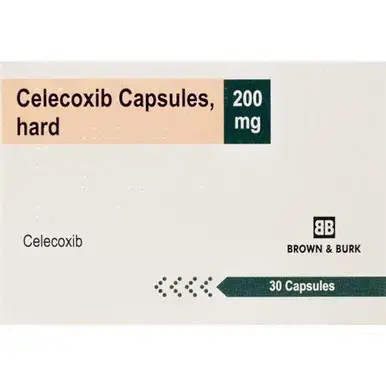
Images for illustrative purposes only
Looking for Next Day delivery?
Order before 15:30 on Monday to Friday for next day delivery
Celecoxib Capsules
- Eases the pain, stiffness and swelling of osteoarthritis, rheumatoid arthritis and ankylosing spondylitis
- Taken once or twice a day, with or without food. It may start to work within hours, but the full effect can take several days
What it is for
Sore, stiff joints that do not settle? Celecoxib capsules ease the pain and swelling of three long-term conditions:
- osteoarthritis - wear of the cartilage that cushions the ends of your bones
- rheumatoid arthritis - a condition where your immune system inflames your joints
- ankylosing spondylitis - inflammation of your spine and the joints where it meets your pelvis
Celecoxib is licensed for adults. It eases symptoms. It does not cure the condition behind them.
Next step: answer our health questions when you order. A prescriber checks them before anything is sent.
Celecoxib may increase your risk of heart problems, including a heart attack. The risk may rise with higher doses and longer use. So take the lowest dose that controls your pain, for no longer than you need it. Do not take it at all if you have heart failure, angina or poor circulation in your legs. The same goes if you have ever had a heart attack, a stroke or a mini-stroke.
Is it right for you?
Do not take it if you:
- are allergic to celecoxib or any other ingredient in it
- are allergic to sulfonamides, such as some antibiotics
- have ever had asthma, nasal polyps, a badly blocked nose, an itchy rash or swelling of your face, lips, tongue or throat after aspirin or another anti-inflammatory painkiller (NSAID)
- have a stomach or gut ulcer now, or bleeding in your stomach or gut
- have severe liver disease or severe kidney disease
- have an inflammatory bowel disease, such as Crohn's disease or ulcerative colitis
- have heart failure
- have angina, or have had a heart attack, or have blocked blood vessels to your heart or brain
- have had a stroke or a mini-stroke (transient ischaemic attack, or TIA)
- have poor circulation in your legs (peripheral arterial disease), or have had surgery on the arteries of your legs
- are pregnant, or could get pregnant and are not using effective contraception
- are breastfeeding
Talk to our prescriber before you take it if you:
- have had a stomach ulcer or bleeding in the past
- take aspirin, even a low dose for your heart, or another medicine that stops blood clotting
- take steroid tablets, such as prednisolone
- smoke, or have diabetes, high blood pressure or high cholesterol
- have heart, liver or kidney problems
- have swollen ankles or feet from fluid build-up
- are dehydrated, for example after being sick or having diarrhoea, or because you take water tablets
- have had a serious allergic or skin reaction to any medicine
- feel ill with an infection - celecoxib can hide a fever
- are over 65, and especially if you weigh less than 50 kg
- are planning a pregnancy, or finding it hard to get pregnant
Have you been told you cannot digest some sugars? Talk to our prescriber first. Every celecoxib capsule we may send contains lactose.
Your blood pressure
High blood pressure is the most common side effect of celecoxib. It can start new high blood pressure, or make the high blood pressure you already have worse.
So expect your blood pressure to be checked closely when you start, and from time to time while you keep taking it.
Your heart, stomach, kidneys and liver
Heart. It can cause fluid build-up and swelling. Use it with care if you have had heart problems or high blood pressure. Chest pain, or short of breath? Stop taking it and get medical help straight away.
Stomach and gut. Ulcers, bleeding and holes in the gut wall (perforation) can happen, and some have been fatal. Your risk is higher if you are older, drink alcohol, have had an ulcer before, or take aspirin, steroids or another anti-inflammatory painkiller.
Kidneys. Anti-inflammatory painkillers can harm your kidneys. The risk is highest if your kidneys, heart or liver already work poorly, or if you are older. Water tablets and some blood pressure medicines raise it too. If you are dehydrated, tell our prescriber before you start.
Liver. Severe liver reactions have been reported, including liver failure. Most started within the first month. If you have moderate liver disease, you start on half the usual dose.
How to take it
Swallow the capsules with a drink of water, with or without food. Try to take each dose at the same time each day.
Your condition sets the dose:
| Condition | Usual dose | Highest dose |
|---|---|---|
| Osteoarthritis | 200 mg a day - one 200 mg capsule once a day, or one 100 mg capsule twice a day | 200 mg twice a day |
| Rheumatoid arthritis | 200 mg a day - one 100 mg capsule twice a day | 200 mg twice a day |
| Ankylosing spondylitis | 200 mg a day - one 200 mg capsule once a day, or one 100 mg capsule twice a day | 400 mg a day, once or in two doses |
Never take more than 400 mg in a day. That is four 100 mg capsules, or two 200 mg capsules.
Not feeling any better after two weeks? Contact our prescriber. Your treatment should be reviewed from time to time, and you should take the lowest dose that works for the shortest time.
You may need a lower dose if you have liver or kidney problems. The same goes if you take fluconazole for a fungal infection. And if you have been told your body breaks down some medicines slowly (a CYP2C9 poor metaboliser), tell our prescriber.
Trouble swallowing capsules? Some makers' capsules can be opened. Empty the whole capsule onto a level teaspoon of cool or room-temperature applesauce, rice pudding (rice gruel), yogurt or mashed banana. Swallow it straight away with a drink of about 240 ml of water. Do not chew or crush the granules. Other makers' capsules must be swallowed whole, so check the leaflet in your pack before you open one.
Missed a dose? Take it as soon as you remember. Never take two to make up for one you missed.
Taken too many? Contact a doctor, pharmacist or hospital straight away, and take the pack with you.
Want to stop? Talk to our prescriber first. Stopping suddenly may make your symptoms worse. You may be told to lower the dose over a few days.
Pregnancy, breastfeeding and fertility
Do not take celecoxib if you are pregnant. If you could get pregnant, you must use effective contraception while you take it. Get pregnant during treatment? Stop it and contact your doctor.
Do not breastfeed while you take it.
It may make it harder to get pregnant. Tell our prescriber if you are planning a baby or having trouble getting pregnant.
Driving
It can make you dizzy, drowsy or give you a spinning feeling (vertigo). If it does, do not drive or use machines until it wears off.
Alcohol
Drinking alcohol while you take an anti-inflammatory painkiller may raise your risk of stomach and gut problems.
Other medicines
Tell our prescriber about every medicine you take, including ones you buy without a prescription. These need care with celecoxib:
- blood thinners (anticoagulants), such as warfarin, apixaban, dabigatran or rivaroxaban - your risk of bleeding goes up
- for blood pressure or heart failure: ACE inhibitors, angiotensin II receptor blockers, beta blockers and water tablets (diuretics)
- to calm the immune system: ciclosporin or tacrolimus
- lithium, for some types of depression
- methotrexate, for rheumatoid arthritis, psoriasis or leukaemia
- fluconazole, for fungal infections - you take half the usual celecoxib dose
- rifampicin, carbamazepine or barbiturates - these can lower the level of celecoxib in your blood
- antidepressants, antipsychotics (neuroleptics) and medicines for an irregular heartbeat - celecoxib can raise the level of some of these in your blood
- dextromethorphan, a cough medicine
- steroids, such as prednisolone, and other medicines that stop platelets clumping (antiplatelets)
Aspirin. You can take celecoxib with low-dose aspirin (75 mg a day or less). Ask our prescriber first. Do not stop the aspirin, because celecoxib does not protect your heart the way aspirin does. Taking the two together does raise the risk of a stomach ulcer.
Avoid other anti-inflammatory painkillers, such as ibuprofen or diclofenac, while you take it.
What it is and how it works
Celecoxib belongs to a group of medicines called non-steroidal anti-inflammatory drugs (NSAIDs). Within that group, it is a selective COX-2 inhibitor.
When your joints are inflamed, your body makes more of the chemicals (prostaglandins) that cause pain and swelling. Celecoxib lowers how much of them your body makes.
Celebrex is the original brand of celecoxib. This page is for generic celecoxib - the same medicine, sold under its own name rather than a brand name.
What it will not do
- It does not cure arthritis. It eases the pain, stiffness and swelling.
- It is not licensed for gout. For a gout attack, see etoricoxib tablets.
- It does not protect your heart the way low-dose aspirin does.
Looking for something else? Browse our pain range, or ask our pharmacy team which option suits you.
The one very common side effect is high blood pressure. Most other side effects are common or less often.
Stop taking celecoxib and tell a doctor straight away if you get any of these:
- an allergic reaction, such as a skin rash, a swollen face, wheezing or trouble breathing
- heart problems, such as chest pain
- severe stomach pain, or any sign of bleeding in your stomach or gut, such as black or bloodstained poo, or being sick with blood
- a skin reaction, such as a rash, blisters or peeling skin - most serious skin reactions start in the first month
- signs of liver failure, such as feeling sick, diarrhoea, or yellow skin or yellow whites of your eyes (jaundice)
Very common - may affect more than 1 in 10 people:
- high blood pressure, or worse high blood pressure if you already have it
Common - may affect up to 1 in 10 people:
- heart attack
- fluid build-up, with swollen ankles, legs or hands
- urine infections
- shortness of breath, sinus problems, a blocked or runny nose, sore throat, cough, colds, flu-like symptoms
- dizziness, trouble sleeping
- being sick, stomach ache, diarrhoea, indigestion, wind, trouble swallowing, feeling sick
- rash, itching
- stiff muscles, painful joints
- headache
- existing allergies getting worse
- accidental injury
Uncommon - may affect up to 1 in 100 people:
- stroke
- heart failure, a pounding or fast heartbeat (palpitations)
- changes in liver or kidney blood tests
- anaemia, which can make you tired and breathless
- anxiety, depression, tiredness, drowsiness, pins and needles
- high potassium in your blood
- blurred vision, sore eyes (conjunctivitis), ringing in the ears, hearing loss
- constipation, burping, mouth pain and sores, an inflamed stomach, gut inflammation getting worse
- leg cramps
- hives, bruising
- wheezing or trouble breathing (bronchospasm)
- chest pain not caused by your heart, a swollen face
Rare - may affect up to 1 in 1,000 people:
- ulcers or bleeding in your stomach, food pipe or gut, a hole in the gut wall, or black stools
- an inflamed pancreas, food pipe or bowel
- low sodium in your blood
- fewer white blood cells or platelets, so you bruise or bleed more easily, or catch infections
- trouble with balance and coordination, confusion, changes in taste, seeing or hearing things that are not there
- skin more sensitive to light, hair loss
- bleeding in the eye
- inflamed lungs, a blood clot in the lungs (sudden breathlessness or sharp pain when you breathe)
- an irregular heartbeat, flushing
- an inflamed liver (hepatitis)
- sudden kidney failure
- period changes
- swelling of the face, lips, mouth, tongue or throat, or trouble swallowing (angioedema)
Very rare - may affect up to 1 in 10,000 people:
- a serious allergic reaction, including anaphylactic shock, which can be fatal
- serious skin conditions, such as Stevens-Johnson syndrome, toxic epidermal necrolysis and exfoliative dermatitis, which cause a rash, blisters or peeling
- red, swollen skin covered in small pus-filled spots (acute generalised exanthematous pustulosis)
- a delayed allergic reaction (DRESS), with a rash, swollen face, fever, swollen glands and abnormal blood tests
- bleeding in the brain, which can be fatal
- inflamed lining of the brain and spinal cord (meningitis)
- epilepsy getting worse
- a blocked artery or vein in the eye, causing some or all loss of sight
- inflamed blood vessels
- fewer of all types of blood cell
- muscle pain and weakness
- loss of taste or smell
- liver failure, liver damage and severe liver inflammation, sometimes fatal or needing a transplant
- kidney inflammation and other kidney problems, such as nephrotic syndrome
Not known:
- lower fertility in women, which usually comes back after stopping
In long studies of high doses (400 mg a day for up to 3 years) in people without arthritis, there were more side effects. Common ones were angina, irritable bowel syndrome, kidney stones, trouble passing urine and weight gain. Uncommon ones included blood clots in the leg, shingles, stomach infections, skin infections, eczema, pneumonia and floaters in the eye.
You can report any side effect to the MHRA through the Yellow Card scheme. Or search for MHRA Yellow Card in the Google Play or Apple App Store.
What is celecoxib used for?
The pain, stiffness and swelling of osteoarthritis, rheumatoid arthritis and ankylosing spondylitis. It eases the symptoms. It does not cure the condition.
How soon will it work?
It may start to work within hours of your first dose. The full effect can take several days. If you feel no better after two weeks, contact our prescriber.
Can I take it if I am allergic to sulfonamide antibiotics?
No. If you are allergic to sulfonamides, you must not take celecoxib. Tell our prescriber about any medicine allergy, because it can raise the risk of a serious skin or allergic reaction.
Can I open the capsules?
It depends on the maker. Some makers' capsules can be opened and the contents mixed into a spoonful of applesauce, yogurt, rice pudding or mashed banana. Others must be swallowed whole. Check the leaflet in your pack first.
Does it contain lactose or gelatin?
Yes, both. Every celecoxib capsule we may send contains lactose, and the capsule shell is made of gelatin. If you cannot digest some sugars, talk to our prescriber before you order.
Is it the same as Celebrex?
Celebrex is the original brand of celecoxib. Generic capsules contain the same active ingredient in the same strengths. The inactive ingredients vary from maker to maker.
Can I take it with low-dose aspirin?
Yes, at 75 mg a day or less, but ask our prescriber first. Keep taking your aspirin. The two together raise the risk of a stomach ulcer.
Can I drink alcohol while taking it?
Alcohol with an anti-inflammatory painkiller may raise your risk of stomach and gut problems. Tell our prescriber if you drink alcohol.
Does it treat gout?
No. Celecoxib is not licensed for gout. For a gout attack, see etoricoxib tablets or ask our pharmacy team.
Can I stop taking it suddenly?
Talk to our prescriber first. Stopping suddenly may make your symptoms worse, and you may be asked to lower the dose over a few days.
Can I take it if I am pregnant or trying for a baby?
Not if you are pregnant. If you could get pregnant, use effective contraception while you take it. It may also make it harder to get pregnant, so tell our prescriber if you are planning a baby.
Can I drive while taking it?
Yes, unless it makes you dizzy, drowsy or gives you a spinning feeling. If it does, do not drive or use machines.
Ingredients
Active ingredient: celecoxib - 100 mg or 200 mg in each capsule.
Other ingredients depend on the maker. Every maker uses lactose monohydrate and a gelatin capsule shell with titanium dioxide (E171). The rest:
- Krka: povidone K30, croscarmellose sodium, sodium laurilsulfate, magnesium stearate (E470b). The 200 mg shell also contains yellow iron oxide (E172).
- Brown & Burk: croscarmellose sodium, povidone K-30, sodium lauryl sulfate, magnesium stearate. Printing ink: shellac, propylene glycol, black iron oxide (E172) and potassium hydroxide.
- Milpharm: hydroxypropyl cellulose, crospovidone (E1202), sodium lauril sulfate (E487), povidone K-30 (E1201), sodium stearyl fumarate. Printing ink: shellac (E904), with indigo carmine aluminium lake (E132) on the 100 mg or yellow iron oxide (E172) on the 200 mg.
Your pack may come from any of these makers. The leaflet inside your pack is the one that applies to your capsules.
Lactose per capsule
| Maker | 100 mg | 200 mg |
|---|---|---|
| Krka (as lactose) | 24 mg | 47 mg |
| Brown & Burk (as lactose monohydrate) | 25 mg | 50 mg |
| Milpharm (as lactose) | 20.33 mg | 40.66 mg |
Storage
- Keep it out of the sight and reach of children.
- How to store it depends on the maker. Follow the instructions on your pack.
- Do not use it after the expiry date on the pack.
- Do not throw medicines away in wastewater or household rubbish. Ask your pharmacist how to get rid of any you no longer need.
Leaflet
Read the leaflet in the pack before you take your first capsule. Each maker's leaflet is linked below.
Related
- Etoricoxib tablets - another COX-2 inhibitor, also licensed for gout attacks
- Naproxen - another anti-inflammatory painkiller (NSAID)
- Pain - our full range
Sources
The facts on this page come from these documents, for each maker your pack may come from:
- Celecoxib capsules (Krka UK Ltd): Summary of Product Characteristics (emc) for 100 mg and 200 mg - revised 13 October 2021; patient information leaflet (emc) - revised June 2020
- Celecoxib capsules (Brown & Burk UK Ltd): SmPC (emc) for 100 mg and 200 mg - revised 27 May 2020; leaflet (emc) - revised April 2023
- Celecoxib capsules (Aurobindo Pharma - Milpharm Ltd): SmPC (emc) for 100 mg and 200 mg - revised 13 May 2026; leaflet (emc) - revised October 2025
- MHRA Yellow Card scheme - how to report a side effect
Each maker's leaflet covers both strengths. The leaflet inside your pack is the one that applies to your capsules. Last checked against these sources: 9 November 2026.

