
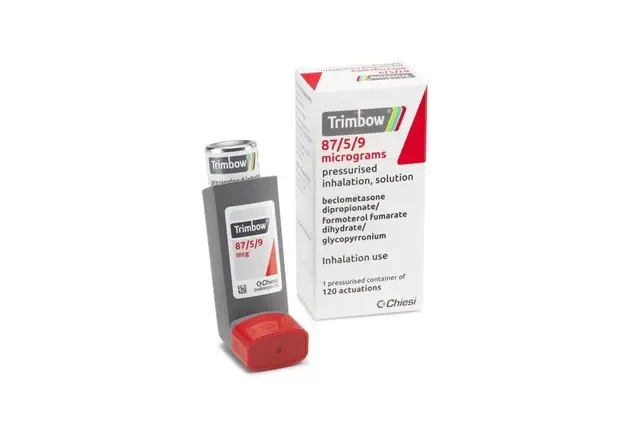
Images for illustrative purposes only
Looking for Next Day delivery?
Order before 15:30 on Monday to Friday for next day delivery
Trimbow
- For adults already prescribed Trimbow for asthma - repeat supply only
- A daily preventer with three medicines in one inhaler: a steroid and two long-acting medicines that open your airways
- Two puffs in the morning and two at night, even when you feel well. It helps stop symptoms and can cut down flare-ups
- Not a reliever. Keep your separate quick-acting reliever inhaler with you at all times
What it is for
Trimbow is a daily preventer inhaler for asthma. Used every day, it helps relieve and prevent shortness of breath, wheezing and cough. It can also reduce flare-ups of your asthma.
It is for asthma that is still not under control on a preventer with a steroid and a long-acting medicine. You will also have had at least one flare-up in the past year. So it is not a first inhaler. It is a step on from the one you used before.
The 87/5/9 strength is also licensed for COPD, but we only supply it for asthma - see your GP.
Next step: for adults already using Trimbow for asthma - repeat supply only. Start our health questions when you order. Your inhaler is only sent once a prescriber has checked your answers.
- Trimbow does not treat a sudden asthma attack. Always carry a separate quick-acting reliever inhaler for sudden wheezing or breathlessness, and use that instead.
Which strength is which?
| Trimbow 87/5/9 | Trimbow 172/5/9 | |
|---|---|---|
| Steroid dose in each puff (beclometasone, from the mouthpiece) | 87 micrograms | 172 micrograms |
| Usual step before Trimbow | A steroid preventer at a medium dose, with a long-acting medicine | A steroid preventer at a high dose, with a long-acting medicine |
| Dose | 2 puffs twice a day | 2 puffs twice a day |
| Puffs per inhaler | 60, 120 or 180 | 60 or 120 |
Both strengths hold the same amount of formoterol and glycopyrronium. Only the steroid is different.
Order the strength you already use. Do not move between strengths on your own: only your doctor changes it, after a review.
Is it right for you?
Trimbow is licensed for adults. It must not be given to anyone under 18.
Do not use it if you are allergic to beclometasone dipropionate, formoterol fumarate dihydrate, glycopyrronium or any of the other ingredients.
Talk to our prescriber before you use it if you:
- have a heart problem, such as angina, a recent heart attack, heart failure, narrowed arteries around your heart, heart valve disease, or a thickened heart muscle (HOCM)
- have an uneven or fast heartbeat, or palpitations, or have been told your heart trace (ECG) is abnormal
- have narrowed arteries, high blood pressure, or a bulge in a blood vessel wall (an aneurysm)
- have an overactive thyroid gland
- have low potassium in your blood
- have liver or kidney disease
- have diabetes - high doses of formoterol can raise your blood sugar, so you may need extra blood sugar tests
- have a tumour of the adrenal gland (phaeochromocytoma)
- have an eye problem called narrow-angle glaucoma
- find it hard to pass urine
- have, or have had, tuberculosis (TB), or have a chest infection
- have an infection of the mouth or throat
- are due to have an anaesthetic - you may need to stop Trimbow at least 12 hours before
- are pregnant, might be, are planning a baby, or are breast-feeding
If you have any other medical problem or allergy, or you are not sure Trimbow suits you, ask us before you order.
How it works
Each puff holds three medicines.
- Beclometasone dipropionate is a corticosteroid. It brings down swelling and irritation in your lungs.
- Formoterol is a long-acting bronchodilator, a medicine that relaxes the muscles around your airways.
- Glycopyrronium is a long-acting bronchodilator too. It works in a different way from formoterol, and together they help open your airways wider so you can breathe more easily.
The medicine comes out as very fine (extrafine) particles. Because of this, the steroid dose can be lower than in some other beclometasone inhalers. 100 micrograms of beclometasone in Trimbow matches 250 micrograms in a non-extrafine inhaler. If you used a different beclometasone inhaler before, your doctor works out the right dose.
How to use it
Take 2 puffs in the morning and 2 puffs in the evening. Use it every day, even when your asthma is not troubling you.
That is also the most you should take. Do not use more than your doctor tells you to.
Between doses, if symptoms come on, use your quick-acting reliever inhaler - never extra puffs of Trimbow.
Missed a dose? Take it as soon as you remember. If your next dose is nearly due, skip the missed one and carry on as normal. Do not double the dose.
Used too much? You may get some of the side effects listed in the Side effects tab. Tell your doctor; they may want to do some blood tests.
Want to stop or lower the dose? Talk to your doctor first, even if you feel better or have no symptoms. Your doctor checks your treatment regularly and may lower the dose if your asthma stays well controlled.
If your asthma gets worse
See a doctor straight away if your symptoms get worse or are hard to control. The same goes if you are using your reliever more often, or your reliever does not help. Your asthma may be getting worse, and your treatment may need to change.
If Trimbow does not seem to be working well, keep using it and talk to your doctor. Do not stop it suddenly.
Using your inhaler
Test it first. Before you use a new inhaler for the first time:
- Check the counter. It should read 61 or 121, or 180 on a 180-puff inhaler.
- Take the cap off the mouthpiece.
- Hold the inhaler upright, mouthpiece at the bottom.
- Point it away from you and press the canister firmly to release one puff.
- Check the counter again. It should now read 60, 120 or 180.
Take a puff. Stand or sit up straight. Do not rush steps 2 to 5.
- Take the cap off and check the mouthpiece is clean, with no dust or dirt.
- Breathe out slowly and as deeply as you comfortably can.
- Hold the inhaler upright, mouthpiece at the bottom. Put the mouthpiece between your teeth without biting it, close your lips around it and keep your tongue flat underneath.
- Breathe in slowly and deeply through your mouth until your lungs are full - about 4 to 5 seconds. Just after you start to breathe in, press firmly on the top of the canister to release one puff.
- Hold your breath for as long as you can. Then take the inhaler out and breathe out slowly, not into the inhaler.
- Check the counter has moved.
For the second puff, keep the inhaler upright for about half a minute, then repeat steps 2 to 5. Put the cap back on when you finish.
See a mist coming from the top of the inhaler or the sides of your mouth? Then the medicine has not reached your lungs. Take another puff, starting again at step 2.
Rinse your mouth, gargle with water (do not swallow it) or brush your teeth after each use. This helps prevent a fungal infection in your mouth and throat (thrush).
Weak grip? Hold the inhaler with both hands - both index fingers on top of the canister, both thumbs on the base.
Find it hard to press and breathe in at the same time? You may use an AeroChamber Plus spacer with Trimbow. Ask your doctor or pharmacist to show you how, and follow the leaflet that comes with the spacer, including how to clean it.
The dose counter
The counter on the back shows how many puffs are left.
- On 60- and 120-puff inhalers it counts down by one with each puff.
- On the 180-puff inhaler (87/5/9 only), an indicator turns a little with each puff and shows what is left in steps of 20.
Order a new inhaler when it shows 20. Stop using it at 0 - what is left may not give you a full puff. Try not to drop the inhaler, as that can make the counter move.
Cleaning
Clean it once a week. Pull the cap off the mouthpiece. Wipe the inside and outside of the mouthpiece and the inhaler with a clean, dry cloth or tissue, then put the cap back. Do not take the canister out, and never use water or any other liquid.
Other medicines
Tell our prescriber about every medicine you take, including ones you buy yourself and eye drops.
- Beta-blockers, including beta-blocker eye drops. Do not use them with Trimbow unless your doctor has chosen one that does not affect your breathing. They can weaken formoterol or stop it working.
- Other inhalers or medicines like the ones in Trimbow. Another medicine that works like formoterol can add to its effects. Using another anticholinergic medicine (one that works like glycopyrronium) with Trimbow long term is not recommended.
- Ritonavir or cobicistat (for HIV) - can increase the effects of Trimbow, so your doctor may watch you more closely.
- Medicines that can change your heart trace (ECG). They can also make an uneven heartbeat more likely. These include quinidine, disopyramide and procainamide for heart rhythm, antihistamines and phenothiazines. Some antidepressants do it too: MAOIs such as phenelzine and isocarboxazid, and tricyclics such as amitriptyline and imipramine.
- MAOIs and similar medicines, including furazolidone and procarbazine - can raise your blood pressure.
- Levodopa (for Parkinson's), levothyroxine (for an underactive thyroid) and oxytocin - can make formoterol side effects on the heart more likely. So can alcohol.
- Digoxin, diuretics (water tablets), theophylline, aminophylline and steroids - can lower your potassium. Low potassium can make an uneven heartbeat more likely.
- Disulfiram or metronidazole - Trimbow holds a small amount of alcohol. With these medicines it can make you feel or be sick, or give you stomach pain.
Some anaesthetics raise the risk of an uneven heartbeat. Tell your doctor or dentist that you use Trimbow before any operation.
Hospital, operations and stress
If you have used Trimbow, or high doses of another steroid inhaler, for a long time, you may need more steroid at times of stress. That includes going into hospital after an accident, a serious injury, or an operation. Your doctor may give you steroid tablets or an injection to cope.
Pregnancy and breast-feeding
Ask your doctor before you use Trimbow if you are pregnant, think you might be, or are planning a baby. Only use it in pregnancy if your doctor advises you to. It is better avoided during labour, because formoterol can slow the contractions of the womb.
Do not use Trimbow while breast-feeding unless you and your doctor decide together that you should.
Driving
Trimbow is unlikely to affect your ability to drive or use machines.
Alcohol in the inhaler
Each puff holds 8.856 mg of alcohol (ethanol), or 17.712 mg in a dose of two puffs. That is less than 1 ml of wine or beer, and it will not have any noticeable effect.
What it will not do
- It will not stop a sudden asthma attack. Use your reliever for that.
- It is not a first inhaler for asthma.
- We do not start you on Trimbow. If you have not used it before, talk to your GP or asthma nurse.
Looking at other asthma treatments? See our asthma range.
Like all medicines, Trimbow can cause side effects, although not everybody gets them. The common ones are a sore throat, a runny or stuffy nose, thrush in your mouth, a hoarse voice, headache and a urine infection. Rinsing your mouth after each dose helps keep thrush away.
- If your wheezing or shortness of breath gets worse straight after a puff, stop using Trimbow. Use your quick-acting reliever straight away and contact your doctor. This may affect up to 1 in 1,000 people.
- Tell your doctor at once if you get signs of an allergic reaction. A skin allergy, hives, itching or a rash may affect up to 1 in 100 people. Red skin, or swelling of the skin or the lining of your eyes, face, lips or throat, may affect up to 1 in 1,000.
- Watch for eye pain or discomfort, blurred vision that comes and goes, or halos or coloured images, with red eyes. These can be signs of a sudden attack of narrow-angle glaucoma (up to 1 in 10,000 people). Stop using Trimbow and contact your doctor straight away.
Tell your doctor if you get any of these. They could be signs of a lung infection, which may affect up to 1 in 10 people:
- fever or chills
- more mucus, or a change in its colour
- more coughing, or more trouble breathing
Common - may affect up to 1 in 10 people:
- sore throat
- runny or stuffy nose and sneezing
- a fungal infection in your mouth (thrush)
- hoarse voice
- headache
- urine infection (urinary tract infection)
Uncommon - may affect up to 1 in 100 people:
- flu, inflamed sinuses, an itchy, runny or blocked nose, an inflamed ear
- fungal infection of the throat or food pipe (oesophagus), or of the vagina
- restlessness, trembling, dizziness, numbness, a change in or loss of taste
- an uneven heartbeat, an unusually fast heartbeat or other heart rhythm problems, palpitations, changes to your heart trace (ECG)
- red face, more blood flow to some parts of the body, more sweating
- an asthma attack, cough, cough with phlegm, throat irritation, nosebleeds, a red throat
- dry mouth, trouble swallowing, feeling sick, diarrhoea, upset stomach or discomfort after meals, burning lips, tooth decay, a sore mouth with or without ulcers
- rash, hives, itchy skin
- muscle cramps and aches, pain in your arms or legs, pain in the muscles, bones or joints of your chest
- tiredness
- higher blood pressure
- blood test changes: lower levels of some white blood cells (granulocytes), potassium or cortisol; higher levels of sugar, C-reactive protein, platelets, insulin, free fatty acids or ketones
Rare - may affect up to 1 in 1,000 people:
- a fungal infection of the chest
- less appetite
- sleeping too little or too much
- crushing chest pain
- a missed or extra heartbeat, an unusually slow heartbeat
- worse asthma
- blood leaking from a vessel into the tissue around it
- lower blood pressure
- weakness
- pain at the back of your mouth and throat, an inflamed throat, a dry throat
- painful and frequent urination, difficult and painful urination
- inflamed kidneys
Very rare - may affect up to 1 in 10,000 people:
- fewer platelets in your blood
- feeling breathless or short of breath
- swollen hands and feet
- slower growth in children and teenagers
Not known - how often cannot be estimated:
- blurred vision
Using high doses of an inhaled steroid for a long time can, in very rare cases, affect the whole body:
- problems with how your adrenal glands work (adrenal suppression)
- thinner bones (lower bone mineral density)
- cloudy lenses in your eyes (cataract)
Your doctor may check the cortisol level in your blood from time to time. Long-term, high-dose steroid inhalers can also cause depression, or make you feel worried, nervous, over-excited or irritable. How often is not known, and these are more likely in children.
If your eyesight blurs or changes in any other way, contact your doctor.
You can report any side effect to the MHRA through the Yellow Card scheme. Or search for MHRA Yellow Card in the Google Play or Apple App Store.
Can I start Trimbow with you?
No. We only supply Trimbow to adults who already use it for asthma. If you have not used it before, talk to your GP or asthma nurse.
Can I use Trimbow as my reliever?
No. Trimbow is a preventer only, on both strengths. For sudden symptoms, use your separate quick-acting reliever inhaler, and keep it with you.
What is the difference between 87/5/9 and 172/5/9?
Only the steroid dose. The 172/5/9 has twice the beclometasone of the 87/5/9, and both have the same formoterol and glycopyrronium. The 87/5/9 follows a medium-dose steroid preventer; the 172/5/9 follows a high-dose one.
Can I switch strength myself?
No. Order the strength you already use. Only your doctor changes the dose, after reviewing how your asthma is.
Trimbow has three medicines. Why does that matter?
It means one inhaler gives you a steroid plus two long-acting medicines that open your airways in different ways. The third one, glycopyrronium, is also why Trimbow carries a warning about narrow-angle glaucoma and trouble passing urine. Tell our prescriber if either applies to you.
What if I miss a dose?
Take it as soon as you remember. If your next dose is almost due, leave out the one you missed and take the next at the usual time. Never take a double dose to make up.
Can I use a spacer with Trimbow?
Yes, an AeroChamber Plus spacer. It helps if you find it hard to press the inhaler and breathe in at the same time. Ask your doctor or pharmacist to check how you use it.
Does Trimbow contain alcohol?
Yes, a small amount: 8.856 mg of ethanol in each puff. Two puffs hold less than 1 ml of wine or beer. Tell our prescriber if you take disulfiram or metronidazole.
How long can I keep my inhaler once it arrives?
Keep it below 25°C. How long it lasts after it reaches you depends on the pack, so check the date the pharmacy wrote on it. The Storage section below has the details.
Ingredients
Active ingredients, per puff. The dose that leaves the mouthpiece:
- Trimbow 87/5/9: beclometasone dipropionate 87 micrograms, formoterol fumarate dihydrate 5 micrograms and glycopyrronium 9 micrograms (as 11 micrograms glycopyrronium bromide).
- Trimbow 172/5/9: beclometasone dipropionate 172 micrograms, formoterol fumarate dihydrate 5 micrograms and glycopyrronium 9 micrograms (as 11 micrograms glycopyrronium bromide).
The dose that leaves the valve is a little higher. It is 100 micrograms (87/5/9) or 200 micrograms (172/5/9) of beclometasone dipropionate. Both strengths have 6 micrograms of formoterol fumarate dihydrate and 10 micrograms of glycopyrronium (as 12.5 micrograms glycopyrronium bromide).
Other ingredients (both strengths): ethanol anhydrous, hydrochloric acid and the propellant norflurane.
Contains alcohol (ethanol): 8.856 mg per puff.
What is in the pack
A coated aluminium canister in a plastic inhaler with a mouthpiece, a protective cap and a dose counter. The 87/5/9 comes with 60, 120 or 180 puffs, and the 172/5/9 with 60 or 120. The 180-puff inhaler has a dose indicator instead of a counter. Both also come as multipacks of two or three 120-puff inhalers.
Storage
- Keep it out of the sight and reach of children.
- Do not freeze. Do not expose it to temperatures above 50°C, and do not pierce the canister.
- Before it reaches you, the pharmacy keeps it in a fridge.
- Once you have it, keep it below 25°C and use it within:
- 2 months - any 60-puff inhaler
- 4 months - a 120- or 180-puff Trimbow 87/5/9 (single pack or multipack)
- 3 months - a single 120-puff Trimbow 172/5/9
- Trimbow 172/5/9 multipack: keep the multipack in the fridge (2-8°C). Take one inhaler out a few minutes before use so the medicine can warm up. Once in use, keep that inhaler below 25°C for up to 3 months.
- Do not use it after the expiry date on the label and carton.
- Do not throw medicines away in wastewater or household rubbish. Ask your pharmacist how to get rid of an inhaler you no longer use.
Leaflet
Each strength has its own leaflet, linked below. Read the one in your pack before you first use the inhaler.
Related
- Luforbec and Fostair - preventer inhalers with beclometasone and formoterol
- Symbicort - a preventer inhaler with budesonide and formoterol
- Ventolin and Salbutamol - quick-acting reliever inhalers
- Asthma - our full range
Sources
The facts on this page come from these documents:
- Trimbow 87 micrograms/5 micrograms/9 micrograms pressurised inhalation, solution (Chiesi Limited, PLGB 08829/0193): Summary of Product Characteristics (emc) - revised 5 July 2022
- Trimbow 87/5/9 patient information leaflet (emc) - Chiesi, revised June 2024
- Trimbow 172 micrograms/5 micrograms/9 micrograms pressurised inhalation, solution (Chiesi Limited, PLGB 08829/0199): Summary of Product Characteristics (emc) - revised 11 November 2025
- Trimbow 172/5/9 patient information leaflet (emc) - Chiesi, revised April 2022
- MHRA Yellow Card scheme - how to report a side effect
The leaflet inside your pack is the one that applies to your inhaler. Last checked against these sources: 8 November 2026.

